June 3, 2010

From the mountains to the seaside

After 8 days of trekking, away from civilization, I had to get back to the chaos and the heat of the Subcontinent. I had to travel from Yuksom, in the mountains of Sikkim, to Cuddalore, at the coast of Tamil Nadu; a journey of about 2500 km. The trip would take three days: the first day I would take two jeeps to get out of Sikkim; that same day I would take a night bus to Kolkata, from where a plane would fly me to Chennai the next afternoon; I would spend the night in Chennai, and on the third day take two buses to reach Cuddalore. That’s two jeeps, three buses and one plane in three days – a pretty heavy schedule, especially after a cold and almost sleepless week in the mountains.

(me and some of my trekking buddies at the goecha-la pass, a couple of days earlier)


The first jeep brought me to a town called Jorethang, close to the southern border of Sikkim. As soon as I got out of the jeep, I felt like I was back in “real India”. I found myself struggling at a ticket booth, surrounded by pushy Indians who never seemed to have heard of a queue, sweating under the burning sun with my heavy bags. My old frustrations, that I seemed to have abandoned right there on my way to the mountains, came back to me like a tsunami of irritation. But a few moments later, when I ended up on a small, crowded market, seeing all the colors, smelling the spices, feeling the energy, I realized I had a big smile on my face. My love-hate relationship with India was resumed.

After one last bumpy jeep ride and an eventless night in the bus, I got to Kolkata at around 9am. After a couple of minutes I was soaking wet, even the slightest movement causing thick drops of sweat to stream down my face – the heat I had felt in Jorethang was nothing compared to what awaited me down south. When I arrived in Chennai, some 12 hours later, it was even hotter. Chennai has a reputation for being overly hot and crowded. I spent about an hour looking for a hotel at a reasonable price, and when I finally found it, I turned out to be the only guest, all alone in a big, dusty dormitory. I felt tired, lonely and really down, for the first time since I had left Belgium.

The next morning, after a good night’s sleep, I felt much better already. My first stop that day was Pondicherry (officially Puducherry, commonly called Pondy), a former French colonial coastal town. Nowadays, it looks almost completely like any other Indian city, except for the French street names, the policemen who – strangely enough – wear red “képis” and some bakeries and restaurants with so-called French cuisine. Close to the seaside, the streets are more quiet, leading up to the “promenade”, where it’s nice to take a stroll along the water or gaze at the horizon of the Bay of Bengal. I spent a couple of hours in Pondy. I treated myself to a steak with french fries and some bread from the bakery, sunbathed on the beach and drove around on a rented moped. It felt great to cruise along the seaside, the wind in my hair, enjoying the smell of sea and sand and the humbling view of that endless mass of water.

(this is the only, very bad picture I took of the promenade in Pondy)

That night I took a bus to Cuddalore, where I met the Indian family I was going to live with. Bhanu, a 31 year old woman, is the head of the organization “Blessing Kids”, for which I would work as a volunteer. She and her husband picked me up and brought me to their home in Melpattambakkam, a small village 15 km east of Cuddalore. They live in her parents-in-law’s house with their two kids, a 13 year old girl and an 8 year old boy. I felt right at home, petting their dog and fooling around with the little boy. I arrived on a Tuesday; on Friday night we were going to leave on a trip with the family. I was told I would start working after the trip, leaving me a couple of days to settle in Melpattambakkam. I slept in a separate house, in a nice room with a bathroom, a big balcony and even a TV. I would pay a fixed amount per month for the room, the food and the transportation, and work, of course, for free. There is a lot to say about this and about volunteering in general, so I will try to dedicate a separate blog entry to this.

I spent the next few days exploring the surroundings and discovering, little by little, the peculiarities of South India and the state of Tamil Nadu. The setting is very green, dominated by coconut trees, mostly scattered around fields of various crops, sometimes grouped into small woods. The patches without greenery reveal the reddish, ochre colored earth that is characteristic to the region. Melpattambakkam, like many villages, is situated along a crowded road that leads directly to Cuddalore. The commercial centre – hair dressers, copy shops, internet cafés, a myriad of small shops selling food, drinks, fruit, phones, clothes, sweets, etc. – is situated along the side of the main road, while smaller side roads lead to the humble houses where the people live. The side of the road is one continuous string of shops, with virtually no space between different villages. It makes you wonder how so many shops can survive – but then you realize you’re in one of the most highly populated countries in the world. Most of these shops seem to have at least one or two clients at all times. I have been told that owners of the typical small shops – they sell snacks, drinks, cigarettes and all kinds of day-to-day products like tooth paste and mosquito repellent, and you can find everywhere without doing more that a few steps – earn loads of money. Apart from the setting, the food as well is completely different in South India than in North India. Again I had to get used to new and strange names like dosa, idli, parotta, sambar and chutney. With all the palm trees around, it won’t surprise you that they use a lot of coconut in their food here. Coconut happens to be one of the few things I have a very hard time shoving down my throat, but since I don’t really have a choice, I’m slowly starting to like it. One curious detail: while in the North people are totally hooked up to milk tea (chai), in the South they drink more milk coffee. I had never thought I would ever drink so much Nescafe, but with fresh milk and a lot of sugar it can be surprisingly tasty.
(I have much more to say about Tamil Nadu and its culture, but I will do so in a separate blog entry. I have had quite a few remarks on my stories being a bit long. Even though I don’t like to give in to commercial pressure, I understand it and I will try my best, not to make them shorter but to cut them into smaller pieces.)

(since I left earlier than foreseen, I didn’t get any chance to take pictures of the surroundings; I did find this nice picture on the internet, taken near Cuddalore)


After three days in Melpattambakkam, we left on a trip to Ooty, a popular hill station, and Mysore, a city in Karnataka famous for its beautiful palace. Bhanu had rented a minibus with a driver to transport her family, a cousin, an old lady who works for Blessing Kids, a Danish girl that worked for her before me, that girl's mother and a friend of hers, and myself. Being with children and elderly people doesn’t usually lead to crazy adventures, so I will save you the details of our trip. May is holiday season in South India, so the places we went were packed with Indian tourists. The few times Indian mass tourism has crossed my path, I have found it to be of the worst kind: everything for the cheesy picture, mass consumption of useless and ridiculous junk, and worst of all, no respect whatsoever for the environment. As a result, we did a lot of endless queuing with nervous and impatient people for silly five-minute boat or elephant rides. A highlight, though, was the horseback riding in the green hills around Ooty; although my beloved buttocks hurt for several days afterwards, I found it a very pleasant experience. Also worth mentioning is the palace in Mysore, positively one of the most beautiful buildings I’ve seen in India; it looks like it’s right out of a fairy tale. A less pleasant moment was when we had an accident with the van. I was alone with the family when it happened– the Danish girls had gone shopping. We were about to overtake an autorickshaw, when all of a sudden it took a sharp turn. We hit him right on the side, and although we weren’t driving fast, we dragged him for a couple of meters, completely wrecking the autorickshaw, before coming to a stop. I was sure that the driver would be, if not killed, at least very badly hurt. After remaining in shock for a couple of seconds, I wanted to rush out of the van behind Bhanu’s husband, but he stopped me. “Don’t show yourself”, Bhanu explained, “or we pay more.” Seeing the crowd that had gathered in the meantime, and although it seemed cynical to worry about money on such a moment, I stayed inside and hid in the back of the van. After negotiating for fifteen minutes, the men came back and we drove away. Luckily, the driver of the autorickshaw had somehow managed to stay unharmed. We had to pay 3000 rupees (50EUR), even though the witnesses confirmed that we were not in fault. Bhanu says that we would have had to pay 10 times more had they seen me. Even so, apparently, it’s best not to call the police, as they would ask for even more money.

(mysore palace by night)


I was happy when we got back from the trip; I would finally get to do something. Only, I still didn’t know what… (how's that for a cliffhanger! Okay, maybe I do give in to commercial pressure...)

May 15, 2010

Trekking to Goecha La

And so I left on an 8-day trip with people I had met just the night before. Since I was supposed to be heading south, I had only summer clothes, and I didn’t nearly have enough cash to pay for it (there’s no ATM in the small village I was in); well prepared as always. Luckily, I could rent a good jacket, and my kind Danish friend was prepared to lend me a huge amount of money (especially by Indian standards).

The group was nice and international: I shared a guide with a Hungarian girl, a Frenchman, an Aussie, an Israeli and an Indian girl from Mumbai; a different group (but we would always walk and eat with them) was composed of an elderly German couple and a young German girl; and a third group consisted of two Czech couples, with whom we didn’t interact that much. Except for the couples, everybody was traveling on his own, which gave excellent conditions for good social interaction.

The first day, we had to climb to the village of Tsokha (3000m), at 19km from our starting point Yuksom (1800m). The first few hours of the hike were truly beautiful. The trail led us up and down, alongside the flanks of the green hills, offering superb views with waterfalls from high above between the trees and rivers deep down in the valleys. The last six kilometers were a steep ascent to Tsokha. When we paused in a village at 2700m, we noticed the nice view had completely disappeared. Dark clouds had gathered, and echoes of thunder reached us from the other side of the mountain. We left quickly to reach Tsokha in time, but after a few minutes, the first rain drops started to fall. The rain soon turned into a blistering hail, and the small paths into muddy streamlets. By the time we reached the hut, we were soaked to the bone and shivering from the cold. Bad news awaited us: the yaks, which carried our bags with dry clothes, hadn’t arrived yet and were delayed by the storm. To make it worse, it’s illegal to make a fire in Sikkim. Our only source of heat – as would be the case throughout the rest of the journey – was the cup of tea we gratefully accepted from our guide. For more than one hour, which seemed like an eternity, we waited for those damn yaks, unable to get warm in our wet clothes. On the bright side, it did greatly accelerate the social cohesion. Sitting close together, shivering by candlelight; handing each other warm clothes (I lent someone my jacket and borrowed someone else’s pants) and sharing the only available blanket; trying, with frozen hands, to play some tunes on the guitar we had brought; it was cold as hell, but, as the Germans call it, gemütlich. That night set the tone for the rest of the trek. The thunderstorm that had surprised us that day wasn’t just bad luck; the weather followed the same pattern every day. In the morning, the sky was clear, offering sunshine and stunning views. Then, invariably, around noon, clouds would appear on the horizon. Around 2pm, the fog would kick in, and in the late afternoon we would get rain, hail or even snow. Locals know these are just the symptoms of early monsoon; they just forgot two warn us, just as they didn’t really warn us for the cold (“don’t worry, it’s spring!”, dixit the travel agent). So there I was, absolutely unprepared, with my summer clothes and a sleeping bag with a comfort limit of 11°C, when the temperature on some occasions would drop well below zero at night. Every evening I had to fight to get a blanket, and even so I was cold every single night – and I wasn’t the only one. We slept in huts, always with at least one broken window and/or cracks in the walls, so that didn’t really help.

After our first cold night, we were to go from 3000m to 4000m, to a place called Dzongri. Since my travel advice pamphlet urged me not to ascend more than 500m a day above 3000m and my doctor/father had warned me numerous times about altitude sickness, I was a bit worried, which my companions seemed to find quite amusing. Fortunately, apart from a strange pressure in my head and a short moment of feverishness, I turned out to be fine; the guide did confirm that sometimes people get sick, though. The path, that second day, was pretty steep, but the setting was again superb, with lots of rhododendrons and magnolias in bloom. As always, the hike ended in the fog, so we didn’t get the rewarding view at the end. Dzongri is the place where we would acclimatize; we would spend two nights there, to let our bodies get used to the altitude. This acclimatization, though it might sound a bit boring, turned out to be one of the nicest parts of the whole trekking. An American guy and a German girl (both thirty something) were stranded there, waiting for some permit; with them and the others we spent hours chattering, playing games, sipping tea and eating biscuits. Sehr gemütlich indeed! It wasn’t all resting and playing, though; the second day, we woke up at five to climb up to a ridge and see the sunrise. At last we got a first clear view of the magnificent white peaks of the Himalayas. After that, three brave ones (which included, you’ve guessed it, your faithful narrator) ascended to the Dzongri La pass (4500m) for and even better view. Unfortunately, by the time we got there, the clouds had closed on the panorama like big white curtains.

On day four, being fully acclimatized, we walked to Thangsing (3840m), the place from which we would ascend to the pass of Goecha La (4940m), the main objective of the trip, the next day. After walking for some time, we got to a ridge, and my heart leapt up with joy: the white mountains seemed so big and close by! We could finally really see what we were walking to. We arrived in Thangsing in time to admire the extraordinary beauty of the place. It lies at the end of a gigantic plain, formed by a melted glacier. There are hills at both sides of the plain, making it kind of a huge canyon. At the end of this canyon, almost like a fata morgana, emerges a massive mountain with snowy peaks. At the left side of the valley, a turbulent river makes its way through a small gorge of its own. It’s great to sit at the side of the river, shielded from the wind, when the sun shines and the view is splendid…a paradise. But paradise can turn into a kind of hell quickly. After a couple of hours, the nice view and the sun had made room for a dense fog. We were sitting in the hut, trying to ignore the cold by challenging each other with riddles, when all of a sudden we noticed that there was a true blizzard going on outside. Snow poured down from the sky and heavy winds were blowing away the tents, causing their owners to struggle with ropes and rocks. The cold was worse then ever, and we were craving for a source of heat so much that we were even considering making an illegal fire. It wouldn’t have been the first time; some people had plundered the roof of one of the huts for wood. The snow was bad news for us. We were supposed to wake up at 2 that night to ascend to Goecha La, the highlight of the trip. The guide said it might be too dangerous with the snow. It kept snowing and snowing, which further diminished our hope. We decided we would wake up at 2 (we had to leave so early to reach Goecha La before sunrise) and evaluate the situation at that moment, so we went to bed early.
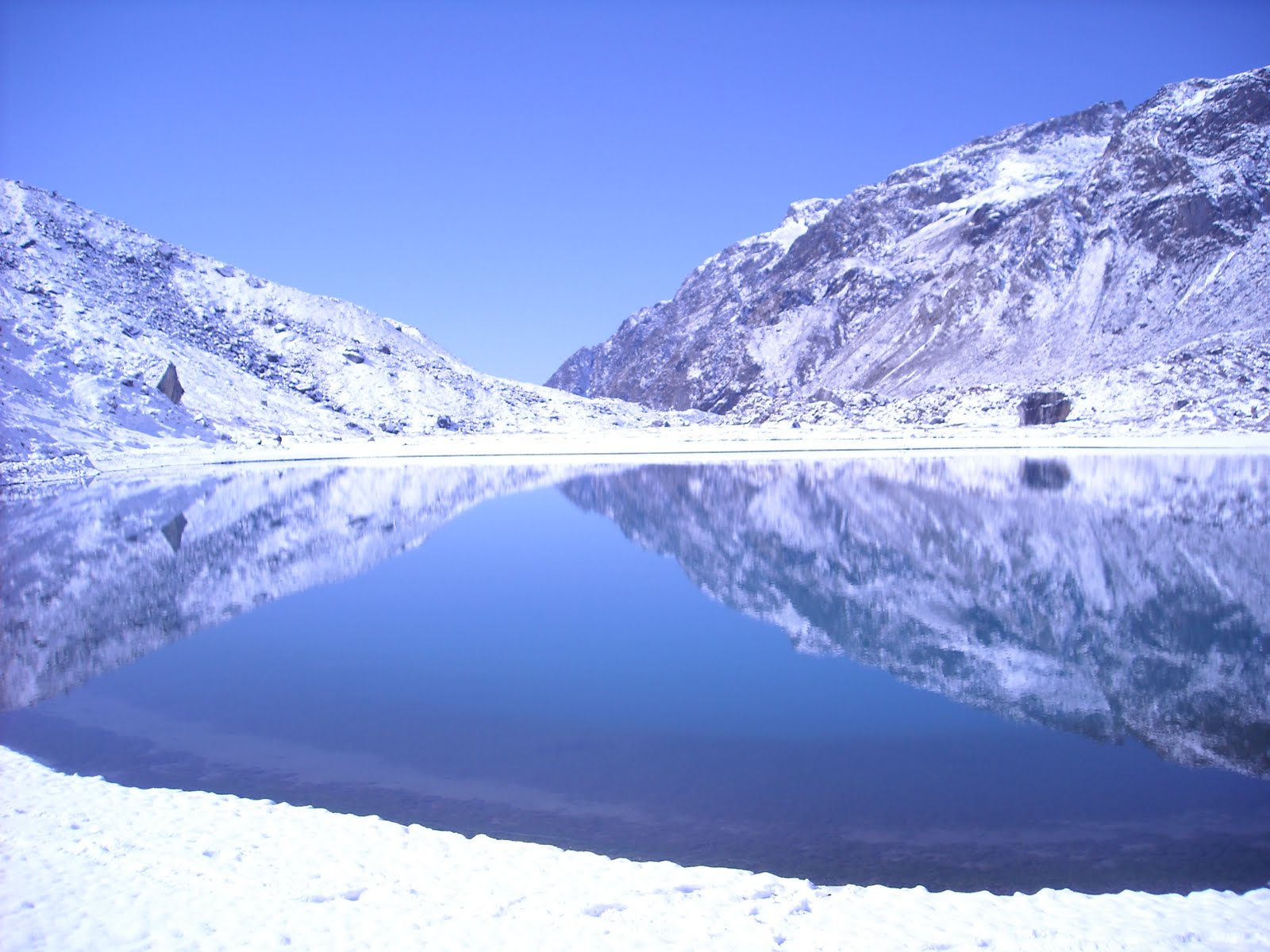
When around midnight nature’s call woke me up (that’s what you get with all that tea) and I somehow found the courage to go out in the cold, it was still snowing and the ground was covered with a white layer of 5cm. Having lost all hope of going to Goecha La that night, I went back to bed, expecting the guide wouldn’t even bother to wake us up. So I wasn’t really mentally prepared when, a bit after 2, the American dashed into our hut: “Wake up, the sky is clear, let’s go!”. Although the snow hadn’t disappeared, the guide considered it worth trying, not promising we would actually reach the pass. So off we went, after a tea and two cookies, in the dark, cold, snowy night with our flashlights. The first part of the hike, we walked in the valley, towards the big mountain at the end. The scenery was beautiful and surreal. With the starry sky and the white, mountainous landscape, I felt like we were walking on the moon. The snow we had cursed so much the night before turned out to be a blessing. There’s a lesson in that… I tried to enjoy the view, although I had to concentrate on the path and the many small rivers we had to cross. After some time, as the stars started slowly disappearing, the typical blue glow of the snow allowed us to turn off our flashlights. Unfortunately, we had only one guide (one was ill), so we couldn’t move faster than the slowest person; we were going to miss the sunrise. As we slowly started climbing, we reached Samti Lake (4200m). This small lake was, to me, the most wonderful place of the whole trek. With its sharp outline and perfectly still surface, it forms a big natural mirror, reflecting the surrounding mountains. The lake is the starting point of a steep ascent to Goecha La. With the sun about to rise, we left the guide with the slower ones and started climbing at an excruciating pace. The air was getting really thin now, and more than once I had to stop to catch my breath. Meanwhile, the sun was already caressing the tops of the highest peaks. Not much later, we reached the pass. We had (kind of) made it! Mount Kangchenjunga (8586m), third highest in the world, The Mountain where it’s all about, was already partially covered by clouds, but it didn’t matter; the view was still amazing. After the first moments of euphoria, we slowly got our senses back: cold! Sweaty from the effort, in the freezing wind, we were cooling down rapidly. We waited for the others to arrive, which took almost one hour. In the meantime, between two pictures, we kept warm by singing and dancing. “Incredible”, I thought, ”I was supposed to be in South India by now, and here I am instead, dancing the Macarena in the snow at 5000m altitude!”. Great moments. New feelings of euphoria arose when the others one by one reached the top - we hadn’t thought they were going to make it. After a quick group picture, we started the descent. Having reached our goal, we could finally take it easy and enjoy the view. By the time we got back to the lake, the sun had risen above the mountain tops. We took a beautiful break there, before heading back to Thangsing. The rest of the day, we got some well-deserved rest. When I saw a group of Indian crew (cooks, porters, etc.) playing football on the plain, I joined them. I had to catch my breath after every action, but it was doable. Football at 4000m altitude, check!

The next 3 days, we slowly headed back to Yuksom. I felt like I was returning from a successful mission, satisfied and enjoying the rest of the time. We visited a couple of nice lakes along the way, but the weather had turned even worse. When we got back to Tsokha (where we had spent the first and the last night), Yuskom was visible far away in the valley: civilization! It’s funny how fast one gets estranged. We were glad to get back to bearable temperatures and relative comfort after our short, but intense trek.

And then it was time to say goodbye again; I had to leave to Kolkata the next morning to catch a plane to Chennai. From North to South, from snow to 40ºC, from the mountains to the coast, everything was going to change again!

Right now I have spent three weeks in Tamil Nadu, living with a local family and working for their organization. I have been teaching English to children in a village for two weeks, which was quite challenging; I’ll write about it soon. I was planning to stay a bit longer, but since it’s summer holidays here, there’s not much work to do. So it’s best for me to travel around in South India for two weeks, and return in June, when the projects will start again. It’s a bit of a pity, because I was just starting to feel a bit at home there, but now I’m in backpacker mode again!

Thanks for reading this and for all the positive comments, it’s nice to hear and encourages me to fulfill my resolution of trying to write a good blog. Feedback is always appreciated! As is news from you, of course:-)

April 18, 2010

A couple of pictures of the trekking (just to make you jealous)

I'll write about it later!


Serendipity vs. planning

Dear friends,

It’s been more than 2 months now since I left. April is coming to an end, so I suppose it’s getting warmer and sunnier back home… how I love spring in Belgium. It’s funny, when I’m thinking of Belgium, I still picture it the way I left it, snowed in and with 1000km of traffic jams. By the way, I just got back from an 8 day trek in the mountains, so I was completely isolated from the rest of the world. On my way back I was wondering what had happened in the world during my absence, and then a German tourist told me Europe was covered by ashes from an Icelandic volcano, making air traffic impossible…Mother Nature vs. Europe 2010, 2-0!

I really got into traveling mode now, meaning I miss home less than before. On the other hand, I’m starting to meet more and more family and friends in my dreams. I’m thinking about my past and future in Europe quite a lot. I guess the “zoom out” effect I hoped to achieve wasn’t an illusion; it’s really easier to think about your life when you step out of it for a while. I just realized I’ve been really traveling for almost one month, so I have loads of things to tell.

My last weekend trip with my friends from Delhi was Agra, home of the Taj Mahal. After that, I would make my way east to Kolkata, and then south, to reach Cuddalore, on the southeast coast, by the 15th of April, to work on a project around HIV/AIDS awareness there. It’s a big cliché, but here we go: although I expected to be disappointed by the Taj Mahal –it can’t but be overrated, I thought – I was most certainly not. The minute I stepped in there, I was completely transfixed. How can a building be so perfect? I must have stood there smiling for two full minutes, completely ignoring the I-must-get-the-perfect-picture-with-the-Taj hysteria that was going on around me. I don’t think I was ever so touched by a human made object. After two days in Agra, I said goodbye to my Delhi friends, with a heavy heart. I was going to miss them, and I was all alone now; suddenly I didn’t feel quite ready to face India on my own.
Some people plan their entire trip in advance, day by day. I didn’t. Part of it is laziness; the main reason is probably that I would feel like a prisoner of my own plans. The only thing I had planned was to be in Cuddalore before the end of April. Like many backpackers, I like to follow serendipity (–noun 1.an aptitude for making desirable discoveries by accident. 2.good fortune; luck, according to dictionary.com) instead. As you will see, it has advantages and disadvantages.
My first stop after Agra was Khajuraho, which houses famous Jain temples with beautiful erotic sculptures. To go there, I had to take a train to the much less interesting town Jhansi, from where I could take a bus. On the train to Jhansi, I met two Indian guys, a textile engineer and an MBA student. I asked them to teach me the rules of cricket; I would play a couple of songs on my guitar in return (I brought the crappy baby guitar I bought in Delhi with the idea I would get rid of it as soon as it would bother me; I still have it with me). One of the guys convinced me to take a later bus so that he could take me on his motorbike and show me Jhansi fort the next morning. It was a lot of fun, and he brought me to the bus station afterwards. Serendipity vs. planning: 1-0.
Khajuraho was quite nice, the carvings are beautiful, and it’s funny to see big groups of traditionally dressed Indian women, with saris and veils, giggle in front of the erotic, or dare I say frankly pornographic, effigies.
To take the train to Varanasi, my next stop, I had to take yet another bus to a small town called Mahoba. When arrived there, I was pushed in shared autorickshaw to the railway station. An auto is usually meant for one driver in the front and three people in the back. In this case, three men shared the driver’s seat, and I was clamped between a couple with a young boy and a baby of a couple of months on the left, and a young woman with what looked like a newborn baby on the right. The road was so bumpy I was afraid the baby would be thrown out of is mother’s ams; the fumes mustn’t have been all too good for the development of his little lungs; and to make things worse, the driver had huge speakers at the back of his vehicle, through which he found desirable to play ear-blasting Bollywood music, accompanied by the flickering neon lights in the front of his rickshaw. But the most amazing thing of all, to me, was that it took me five minutes to realize how absurd and unusual the situation was. I guess one gets used to everything. I reached the train station at 8pm, and my train was scheduled at 1.30am (in the end, it left at 2.30). I managed to hang around in a small restaurant until 10.30, but then they were closing and I had to leave. Like every railway station in India, this one too was converted in a giant dormitory at night, so I laid out my self-inflatable Decathlon mattress on the platform, and was soon fast asleep… only to be woken up by the police:

-Hello
-…
-Hello
-Hello, how do you do?
-You not sleep here.

-What do you mean? I was sleeping great.

-You not sleep here. Not allowed.
I looked around. I was surrounded by dozens of sleeping Indians.
-Only for me not allowed?

-Dangerous.

-Dangerous? I feel safe, I’m surrounded by people.

-You not sleep here. Dangerous. You go police station.

-(sigh)
-Hello
-Yes, hello. I’m still here.
-You go police station. Not sleep here.

-But why not? Why can they sleep here and I can’t?

-They Indians.

-Oh really? I thought Chinese.

-You foreigner. Not allowed.

…
He brought me to a dark bench in a corner. I told him I really didn’t feel safer than on the platform. In the end, he put me under a bright neon light, next to a fat snoring man, with insects falling from the ceiling. I couldn’t get back to sleep. Thanks a lot, Indian police.

Varanasi was interesting (this is the place where corpses are burnt on the banks of the holy Ganges) but touristic, dirty, and full of cheaters. I was told beforehand that everybody got ill in Varanasi. As a proof, I met two British guys who were there to test new patches against diarrhea. They were sent to Varanasi because statistics show that 90% of Englishmen get “the shits” there. After Varanasi, I would go to Bodhgaya, the place where prince Siddharta Gautama reached enlightenment by meditating under a tree, to become the Buddha. The only problem was getting there. When I finally got to the railway station (after a lot of haggling with the driver), I had spent half an hour looking for the right platform, when someone informed me that the train was canceled. At the tourist information center (thank god for those) I met a French guy who told me he had been trying to take that same train for 3 days, and it got canceled every time. After asking approx. 100 people, we found out that we could catch a train at a smaller railway station, at around 10km from there. We managed to get the train, and the French guy was meeting with a Swiss who was in a great hotel, in the middle of the village side of town. Serendipity vs. planning: 2-0 (to be honest, I must say that I met some people who had gone to Orccha, near Jhansi, and they told me it was beautiful, as says my guidebook, which brings the score to 2-1). Bodhgaya was nice and laidback compared to Varanasi, but the other guys had quite a different pace than me (they had met on a meditation course in Nepal), so I didn’t stay there for too long. I was impatient to go to that big city I had heard so many good things about: Kolkata. In the meantime, many people had told me it wasn’t a good idea to go south, because it was really getting too hot. In general, many of the people I met were on their way back from the south, telling me great things, but at the same time warning me for the upcoming heat. I definitely came the wrong season to go to the beautiful south (2-2!). This is why one of my main objectives for Kolkata was finding people to go north, to Darjeeling. More than one Indian had recommended me to go there. The first day, I met a French girl who was going to Assam, a not too touristic place in the northeast, with a beautiful natural reserve where I wanted to go on an elephant safari. In the meantime, many people had told me Darjeeling was foggy (the main attraction is the beautiful view on the nearby Himalayas), so I thought I might join her instead. However, she was leaving the next day, and I wanted to stick around in Kolkata for a little longer. I decided to wait and see if I could meet people that left later. After a couple of days, not having met anyone else going northeast, met a Danish girl who was going to Sikkim. This is another region in the northeast, a beautiful and hilly area that requires a permit (free and easy to get, but still a good filter for mass tourism). A couple of hours after deciding to go to Sikkim instead of Assam, I read an email from the French girl, kindly informing me that the early monsoon made Assam rainy and unpleasant. Serendipity! Kolkata, by the way, was a very fun experience. It’s hard to explain how and why, but Kolkata is a much more pleasant city than Delhi. Dare I say it’s more “European”? My greatest moment was when we woke up at 5 to go practice yoga by a lake in a park, as many Kolkatans do. Still, inevitably, the nice things are only a façade that hides way less romantic aspects of the city. Many people live on the streets; even on Sudder St., the center of backpackersville, you can see dozens “showering” outside every morning. Right around the corner from my hostel, literally at 10m from the entrance, people sit on the side of the street, injecting drugs. And a few blocks away, the top floors of a building burnt down the day before my arrival. They were still digging up bodies when I left but around 50 people got killed. Even though the fire station is five minutes away, the firemen needed 15 minutes to get there, and nearly an hour before they started putting out the fire, so I’ve been told; apparently, the fire exits were blocked as well. Moreover, according to the newspaper, the two top floors were built illegally, and the actual owner is… the government.

After 5 days of Kolkata, I was on my way to Sikkim, with a stop in Darjeeling for a couple of days first. We had to take a bus to Darjeeling because the trains were full; we left at 6pm and it would take approximately 12 hours. After 13 painful and uncomfortable hours, the bus stopped. A strike, we were told. I couldn’t quite figure out why, though. I walked to the road block, that consisted of a simple wooden bench. On the other side of the road, people were gathered around a big plastic sheet on the ground. After closer inspection, I noticed a human-shaped bulge, and a blue sandal lying next to it. Apparently, someone got killed by a truck, and the villagers were protesting against the traffic that rages by their humble houses. The last piece to Darjeeling, done by shared Jeep, I started noticing the people. The looked so different! Though still with Indian features, people from that area have yellowish skin and Nepalese eyes.

Darjeeling is a nice hill town, favorite destination of West-Bengali tourists. From the moment I arrived in Darjeeling till the moment I left Sikkim, the world seemed to revolve around mount Kangchenjunga (still took me more than a week to memorize the name, though). Kangchenjunga is the 3rd biggest mountain in the world, with an elevation of 8586m. When the weather is clear, Darjeeling is dominated by its magnificent white peak. The main attraction is to go up Tiger Hill in Jeep in the early morning to watch the sunrise. Since it’s holiday season in India, Darjeeling was especially packed. The way up to Tiger Hill was a continuous snake of Jeeps. We were brought to a kind of a balcony with dozens, maybe hundreds of Indian tourists struggling to get a good spot. The sun came up in the mist, but when it was finally visible, people rushed to one side of the balcony to take pictures. Not exactly what we were expecting. The only nice moment was when the mountain rose from the clouds, showing its orange colored flanks. Apart from that, we did beautiful walks in the tea plantations, and to the Buddhist monastery on top of a hill, where the strong winds rushed through thousands of Tibetan prayer flags.

After two days of Darjeeling, we were off to Sikkim. This small stub of land is squeezed in between West-Bengal (south), Nepal (west), Tibet (north and east) and Bhutan (southeast), so you can imagine it’s something special. It’s a small paradise, with beautiful green hills, rivers, waterfalls, and white peaks (Kangchenjunga is on the border between Sikkim and Nepal). It’s not easy to get around there; only shared Jeeps can get you from one village to another, and they are quite scarce. Unfortunately, everywhere we went, people were building roads, bridges and tunnels; probably the beginning of the end for the authenticity of the region. Just as in Darjeeling, beautiful views of The Mountain were hidden by fog. We were starting to think the pictures on postcards were made with Photoshop. Luckily, nice monasteries and lakes offered us a relaxing time. From the small village Yuksom (no ATM’s and only one computer with internet) we did a one day trek through the beautiful green landscapes. I was nice and relaxing to be there, without having planned anything in advance; 3-2 for serendipity. On our way back to Yuksom after the trek I was thinking about what to do next, since the Danish girl was leaving to Varanasi the next day. I walked into the hotel, and a guy asks: “Do you guys want to go trekking?” Yuksom is the starting point for treks towards the Himalaya, with breathtaking views on the snowy peaks. Three Israeli guys were about to leave for a 6 day trek and were looking for more people, to get the price down. I had only 10 minutes to decide… Most people leave for 8 days, but my permit was only valid for 7 more days, so a 6 day trip was perfect…I was going to do it. 4-2? We planned to leave the next day at 8.30. We lost some time because one of the guys, who needed a horse because he has ruined one of his knees in the army, was insisting on having a good saddle. When we finally got to the starting point, the horseman told us it was impossible for the horse to go downhill with someone on his back. The organizer had lied, the guy with the bad knee couldn’t go, so the trip got canceled. Completely lost, I followed them to the hotel where they had stayed before, and checked into a dormroom. Some nice people were there, packing their bags to leave on a 8 day trek the next day. By that time I had really gotten caught up with the idea of going trekking. Luckily, I could still join them, and the organizer could extend the permit for me. 4-2!
(I didn’t have the time to write about the trekking yet, so I’ll do that in a later post…but it was awesome! Right now I'm on my way to Cuddalore, where I will work for Blessing Kids.)

March 19, 2010

Some pictures of Rajasthan

Jaipur

Jodhpur
Camel Safari

On my to-do-list it says "blog" and you know how I'm always faithful to my to-do-list so that's why I'll tell you something about my project and all

Time flies... this is my last day in Delhi. A couple of weeks ago, all I wanted was to get out of here as soon as possible. Now I realize I'll miss the comfort of having a place to stay, the fun of having fixed friends and the convenience of knowing your way around. I'm about to hit the road.

The last two weeks have been quite interesting and fun. As I told you in my previous post, the purpose was to inform school children and college students about HIV/AIDS. To this end, we would first "work" in an NGO in that field for two weeks, meaning we would mainly observe and acquire knowledge in this way, and occasionally help out if possible. I'm not a very big fan of the concept - I hoped to find a project where I would actually DO something - but that's the best I could find. And it turned out to be quite interesting. The NGO, Sahara House, started off as a care center for drug addicts. Through the years, they realized that a lot of drug users got infected with HIV, because of shared needles. Today, Sahara House has various projects throughout Delhi as well as in other cities in India. The interesting thing is that 90% of the employees are former drug addicts and/or seropositive. We visited three projects, each for a period of three days.
The first three days we went to a place called "Michael's Care Home", which shelters people with AIDS, and helps them to deal with the hospitals (apparently, a lot of doctors are still very reluctant to treat AIDS patients). The doctor at Michael's Care Home taught us a lot about HIV and AIDS, which was quite interesting. We interacted with patients (they call them "clients", for some reason I couldn't really find out); some their life stories are still resonating in my head.
The hardest part was the second project. Sahara has an outreach program in a slum area with a lot of injecting drug users (IDU). They talk to these people and get them into detox and rehab if they are ready for it. Otherwise, they provide clean needles and syringes, or oral substitutes for the drugs, to at least prevent HIV from spreading (this is called harm reduction). The HIV incidence in those areas is estimated at about 10 to 20% (government and independent numbers tend to differ). What you see there is close to what hell must look like. People literally live in garbage, with nothing on their minds but drugs. You can see them injecting their stuff, in the strangest parts of their body because they have no proper veins left. I've shaken hands with dozens of them, some of them told me their stories. I've talked to people I would normally run away from. We were escorted by one of the outreach workers, and it was impressive to see how everyone there knows him and respects him - they even call him "boss". It made me realize they are lucky that some people do not run away from them. Despite the thick mental shield you inevitably develop when seeing such misery, three days of confrontation with this godforsaken place really get to you. The hardest for me was the absurd contrast between being in the slums during daytime and being with AIESEC people at night. I tried it, because life goes on and all that, but it's quite impossible to have a good time in some fancy club when you saw people living like animals just a couple of hours before. I never saw so clearly how deeply cynical this world is.

After seeing all that misery, the third project felt like paradise. The Women and Children's Home provides shelter (as well as detox and rehab) for women with drug problems and/or HIV, as well as a crèche for their kids. We interacted with the women and I must say we really had a lot of fun. Of course, there again, most of them could have written a book about life stories. That is, if they would have been able to write. Several women there are completely illiterate. I never realized that illiteracy sometimes means that they aren't even capable of drawing. We tried to play some kind of pictionary, and for some of them drawing a spider or a mouse was an impossible task. This made me realize I spent 20 years of my life, almost full time, educating myself. We have so much knowledge, and we really take it for granted. All we do is looking up to people who know even more, to the point that we think our knowledge is only basic. But when I interact with these people I realize that I have everything, and they have nothing. I travel around the world, while they barely understand the concept of a map or a globe. Education, education, education. Everyone says it, but I never fully understood it until now. Education is the only way of getting chances in this cruel world. Most of these women are strong and beautiful and, in their way, intelligent, but without education, they are helpless.

Yesterday we gave our first and last presentation about HIV/AIDS in a school. Quite frankly, I couldn't help but feel like we were at least partially used as a promotional tool for AIESEC. Our audience consisted of 12th graders, meaning they will go to college next year, a good moment to join AIESEC. Anyway, they at least acted as if they were interested in what we had to say about HIV/AIDS, so it wasn't that bad. That presentation was the only useful thing we did in this whole project, though, so it goes without saying that I'm not really satisfied. It really felt like some perverted kind of tourism sometimes, seeing AIDS patients and drug addicts to later brag about it in your blog. The only way I can reconcile with it is if it actually makes me do something about it. I'm sure some of us (most of us?) will go back to their countries, show the pictures of slums and drug addicts to their friends, and then go on with their little luxury lives. I understand it, and I can't even guarantee I won't do the same, but I find it, once again, cynical.

In the weekends, we went traveling in Rajasthan. I will keep it short because it's probably boring. Some crazy/funny things did happen, but I hope to talk about it some other time. Two weeks ago we went to Jaipur, the Pink City. A chaotic and noisy city, but it felt like a small village compared to Delhi. Nice forts in the rocky Rajasthani hills, splendid views, great tourism. Last weekend we went to Jodhpur and to Jaisalmer, where we did a camel safari. Jodhpur is the Blue City, so same story as Jaipur but different. Jaisalmer, the Golden City, is located in the Thar desert and is the proud owner of a beautiful fort made out of sandstone. I think it used to be a magnificent city, but it is completely spoilt by tourism. We went on a "non-touristic camel safari" (like all tourists do) and spent a night in the desert. We slept under the stars, saw sunrise and sunset, beautiful experience.

So, as this whole crazy continent is heating up like a furnace, I have the brilliant plan of heading south, where it's the hottest. I have the opportunity of working in a HIV/AIDS project for an NGO in Cuddalore, in the state of Tamil Nadu, on the southeast coast of India. I'm planning to head southeast slowly, doing some tourism along the way, to arrive in Cuddalore in about a month. How long my project will last is not clear yet, I guess it will depend on how well it goes. Tomorrow I'm going to Agra (there's supposed to be a nice building called the Taj something) with some people I met here, and then I will head east. I should be in Kolkata by the end of next week. I'll try my best to keep you updated.

I'll try to upload some pictures, if my connection is not too slow.

March 4, 2010

Delhi and a nice weekend in the north

Dear friends,
I've been meaning to write for more than a week now, so there's a lot to tell. I was in the process of writing a long text about Delhi, but I'll shorten it a bit to talk more about last weekend, which was truly wonderful.
But first, Delhi. Once I got over the excitement of the first days, small irritations slowly started to attack my nerves. All this talk of "culture shocks" usually makes me laugh, but after barely one week, I couldn't deny it anymore. I was nervous, mean against everyone who spoke to me on the street, weary. In Delhi, everything is complicated and chaotic. Going anywhere requires bargaining and traffic jams; buying anything requires more bargaining; to get a sim card or a train ticket (in some cases), you have to fill out forms and hand in a copy of your passport. As a result, you need one week to do what you would normally do in one day. I have been in Delhi for 3 weeks and apart from visiting and going to parties I haven't really done anything (except learning some Hindi; I'm learning how to read, it's fun! I feel like a child who wants to read everything there is to read). It's really hard to let go of that idea of wanting to do this-and-this-and-that in one day; I thought I was a pretty easy-going guy (or at least capable of being one), but in Delhi I feel really uptight. Apart from these small frustrations, living in Delhi is like living in a permanent mess. The air is bad, the streets are dirty, there's dogs, cows, goats and other animals runnnig around (though less than in the rest of India, I think), and the sound of horns doesn't leave you for one second. Even at home, it's hard to relax. The first two weeks, I lived with Indian guys (apart from two other trainees). A couple of them became really good friends, especially Arnav, who invited us to his home last weekend. The most difficult part of this friendship is that we seem to have totally different ideas of privacy and personal space. In India (or at least here in Delhi), your room is public property. Anyone can come in any time without knocking, which they very often do. This sounds fun, and actually it is (except when it's the supervisor, the cleaning lady or the plumber), but I seem to have the need to be alone every once in a while, and quitely read a book or play the guitar (I bought a baby guitar) without anyone just sitting there and watching me. What's more, they do not make any effort not to make noise when someone is sleeping. Three men shouting in Hindi in your bedroom because they have to fix something is not the best way to wake up. All of this made that after one week, without really having done anything, I felt like I was on the verge of a nervous breakdown. To make things worse, last tuesday we got robbed. Someone came into our appartement (even though some people were home) and took my iPod, my camera, and my Japanese friend's laptop and mobile phone. That was definitely the worst day since I got here, and since then everything got better. But before I get to the positive part, just one last thing. We had a lot of trouble with the housing here. As I told you, I previously lived with Indians. Previously, because they got kicked out. AIESEC Delhi pays a company to arrange for accomodation for the many interns that come to Delhi. What this company did is buy a students house (called a PG or Paying Guesthouse here, actually both students and young working people lived there) and kick the Indians out. The Indian guys with whom I was living all had to leave last weekend. They did get warned a month beforehand, but I find it really hard to accept the idea of Indian students having to leave their home to make room for some foreign trainees. What's more, we really enjoyed their company, so it's sad they had to leave. By the way, people from AIESEC DU (Delhi University) tried to censor me. In my previous post I talked about people having to wait for their internship, and someone from AIESEC apparently read it. They called me and asked me to remove the name of their organisation from my blog, which of course I refused. I have waited for three weeks to start my project (I started yesterday), which will only last for two weeks. In my case it's fine, since I was going to come to India anyway. But other people came all the way to Delhi for 6 weeks just to do a project for only 2 weeks. People need to know that going on an internship with AIESEC India might not be the best idea. To console my would-be censors (hi Sameer and Megha) I should add that some people have really good internships with a lot of responsibility.
Okay, enough negative stuff. Things are quite nice right now. My internship started, so I'm finally doing something (even though it's mainly observation; I'll talk about the project in a later post). And most of all, I had a great weekend. Our friend Arnav invited us (a Russian guy and girl, a Japanese guy, a German girl, a Dutch girl, and me) to his house in the north (in a small town called Roorkee) for the weekend. A long weekend, since monday was Holi, India's biggest festival, which celebrates the end of winter. It was great to get out of the chaos, the noise and the pollution of Delhi. Arnav's house is nice and big, with a rooftop terrace, where we spent much time looking at the full moon. His parents treated us as kings, cooked delicious food, and trying to help out only resulted in a gentle slap on the cheek. We all felt like we were really breathing for the first time in two weeks, so the mood was great. On saturday we went to Mussoorie, the "Queen of the Hills". This town is situated on a ridge at 2 km altitude, offering a great view on the plains below. It was a misty day, but when we went to the north side, far far away, barely visible, we saw them: the white peaks of the Himalaya Range! It made me euphoric, the idea of being on that ridge, with on one side this massive subcontinent I'm about to explore, going south and south and south, and on the other side a glimpse of these mythical, magical Himalayas, where I hope to go at the end of my journey, to rest from all I will have seen and smelled and tasted. On Sunday we went to Rishikesh and Haridwar, two famous pilgrimage centers on the banks of the sacred Ganga. Rishikesh (also famous because the Beatles resided in an ashram there) is very beautiful, but quite touristic. There's a lot of fun things to do, like white water rafting, but unfortunately we didn't get the time. Our stay in Haridwar was short, but interesting. We bathed our feet in the holy Ganga, and I had a truly spiritual moment (yes, me!), bathing in the fast running water of the broad and mythical river by full moon. Monday was Holi, probably the best day of the year to be in India. On Holi, people throw water and colored powder, on anyone and everyone (yes, there are a lot of ecological question marks, but I won't go into that now). We were on Arnav's rooftop, splashing and painting eachother (including Arnav's parents), and throwing buckets of water and waterballoons to people on the street. There was sun, there were colors, everyone was wet and happy, it was a great ending of a beautiful weekend.
It was hard to return to smelly, noisy old (New) Delhi after such a nice weekend, but in the end I was kind of glad to be back. At least I have something to do now, so it's not that bad. The weather is gradually getting hotter and hotter, so I try to enjoy it while it's still bareable. I'll try to write about my internship one of these days. I didn't buy a camera yet, and I'm hesitating to do so. I fell more free without a camera, but on the other hand it would be nice to have something to share with you. Next weekend we're going to Jaipur, the Pink City, which should be a lot of fun. As always, news from your side is more than welcome!