On the night of my third day in Mumbai, I had a train to Aurangabad, a city in the same state of Maharastra. I was on my way to Delhi, and wanted to get there as soon as possible to go further north. The initial, crazy plan was this: night train to Aurangabad, one day there, night bus to Ahmedabad, one day there, night train to Udaipur, two days and one night there, night bus to Ajmer, one day there, night train to Delhi. That's three nights in public transport, one night in a hotel, two nights in public transport. A couple of facts altered my initial plan. One: it was darn crazy. Also, the bus between Aurangabad and Ahmedabad turned out to take 15 hours; night buses are so horrible that I preferred to take two night trains, going back to Mumbai first. And last but not least, I had gotten pretty ill in Mumbai. I spent the night in the train to Aurangabad shivering like hell first, despite being in my sleeping bag with all my clothes on, and glowing with heat after, even though I had taken off my sleeping bag and almost all my clothes.
The purpose of my visit to Aurangabad was the Ajanta caves. These Buddhist and Hindu sanctuaries, carved out of the rocks in the 2nd-1st century BC and 5th century AD, are one of the absolute artistic highlights in India. Since I was ill, I decided I would also visit the nearer by Ellora cave, staying one night in Aurangabad. Since I had come all the way to see the caves, I was determined to do so, despite my condition. I had met an Australian guy on the trains who had the same plans, so I would have some company, which is always more enjoyable. Helped by the necessary medication, I visited the Ellora and Ajanta caves on two consecutive days. The Ellora caves were beautiful and impressive - especially the Kailasanatha temple, which is said to be the largest monolithic structure in Asia - but I was much more impressed by Ajanta. The location is amazing: the caves were carved out of the outer side of a horseshoe-shaped valley. They were forgotten for many centuries, until a British hunting party stumbled upon the site in 1819. But the location is far from being the only fascinating aspect of the Ajanta caves. Where at the Ellora caves it's all about the carvings, the walls of the Ajanta caves are decorated with extraordinarily fine paintings, made with a unique technique involving clay and dung, as well as minerals and plants. Walking around there in the dark cavesm exploring the murals with a flashlight, gives a taste of how it must have been for the discoverers to unveil all those forgotten treasures. Thanks to the medication, I was able to enjoy the caves, but both times, by the times I got back to Aurangabad my fever rose again.
A night train took me back to Mumbai, where I spent another day. Since I felt good that day, and it didn't rain, for once, I visited Elephanta island. This island, a couple of km off the coast, houses yet another collection of caves; I had seen enough of those, but the view on the harbor of Mumbai was magnificent. That night, on the train to Ahmedabad, I noticed I started to get a fierce cough, and the fever once again came back in force. A bit worried about my health, I went to the hospital the next day. Diagnosis: a pretty heavy lung infection. The doctor prescribed me antibiotics and three days of bed rest - just when I was in Ahmedabad, that hot and crowded city where I was only passing through. Since I had no more fever after my visit to the hospital, I left Ahmedabad the next night taking the train to Udaipur. [by the way, as I'm writing this, I'm being bugged by a huge flying cockroach. Flying cockroaches? Evolution, you've gone too far!].
When I arrived in Udaipur, I realized I was pretty glad to be back in Rajasthan, that big and rugged state with colorful people I had visited a couple of times when I was in Delhi. Udaipur is supposed to be a fairy-tale city, with a beautiful palace on a lake. Unfortunately, because of poor monsoons, the lake is almost completely dried out. In fact, the locals had put a couple of hundreds of earthen water jugs there, begging the gods for some rain. Even without water, Udaipur was pretty charming, with people walking around calmly and children playing cricket in the dried-out lake. The next day I went to Ajmer. Once again, the bus drive was great, with the rough Rajasthani landscape populated by people gathered around water pumps, men carrying wood and women bearing several big water pots on their heads, as well as the usual cows, dogs and donkeys. I went to Ajmer mainly to visit nearby Pushkar, a Hindu pilgrimage town, where hundreds of temples are arranged around a lake.A lake that was, surprise surprise, dried out. This time, though, instead of children playing cricket, the lake was replaced by ugly concrete water tanks and bulldozers. I could see that Pushkar must be a really nice place when the water is there, and I enjoyed seeing the people performing their religious rituals (in the water tanks instead of in the lake), but I didn't stay long. I went back to Ajmer, and tired of sight-seeing, I went to a park. To my surprise, I found aesthetic marble pavilions at the side of a beautiful lake...with water! I got into a conversation with some Indian tourists, who were recognizably Sufi's (a type of Muslims). I remembered there was a famous Sufi temple in Ajmer, so a asked them to take me there. I found the same special atmosphere as in the Sufi temple in Delhi; this time without feeling too uncomfortable, thanks to the good company. (Strange coincidence: that same night, there was a big blast at an important Sufi temple in Pakistan)
And then I was on a night train to Delhi! My stay was bound to be different than before, because this time I was going to stay in the backpackers' area. Delhi was hot, rainy, muddy, and as congested as always, but after all these weeks of discovering new places and adjusting to new situations almost daily, it was kind of nice to go back to a vaguely familiar place. The first day was a typical Delhi-day: I had to important things on my to-do list, and I ended stressed out and angry because I managed to do only one. But at night I met up with some old friends, with whom I watched football (the World Cup was on) and went out, which made me forget the bad day. The next day I met my Indian friend Arnav. We went to Gurudwara Bangla Sahib, the Sikh temple I had somehow overlooked before - an excellent preparation for the Golden Temple I would see the next day.
Indeed, my next destination was Amritsar, home to Sikhism's holiest shrine. Sikhism, founded in the 15th century, began as a reaction against the caste system. Sikhs, who live mainly in North India, specifically in the state of Punjab, are very recognizable by some attributes, like their turband, beard and steel bangle. In their religion, there is a lot of emphasis on the equality of all beings. This is very much reflected in the atmosphere at the Golden Temple. Everybody is welcome, and can stay for free in one of the dormitories inside the complex. As is that wasn't enough, they provide free food for everyone. Eating at the Golden Temple is quite an experience. After getting a tin plate and cup, you stand in line before entering a gigantic dining hall. People sit on the floor in long rows, waiting for volunteers to provide them with food and water. After eating, your plate is washed by one of the dozens of volunteers; anyone can join the mass of people who do the dishes under loud clattering of the plates. The kitchen, serving up to 40,000 pilgrims a day, is equally impressive; the pots are taller than the cooks, who stir them with giant spoons. With all this, I haven't even talked about the shrine itself yet. The Golden Temple stands in the middle of a pond, which is surrounded by a walkway and galleries, all in marble. The atmosphere is pretty relaxed, with people walking around, prostrating themselves in front of the temple, or bathing in the holy pool. After crossing a small bridge, you queue up to get inside the shrine. That's when you notice that while the gold-plated upper part was drawing all your attention at first, the marble lower part is beautifully decorated with fine colored inlays, representing flowers and animals. While beautiful changing is resonating in the whole complex, you procede to the inside of the temple, the very heart of Sikhism. People are praying and bowing, the musicians are playing in the center, the atmosphere is amazing. The interior design is what I would usually call kitsch: golden decoration on a background of green, red and blue - but somehow, it works. You can get up to the roof, where you get a nice view of the people strolling on the walkway.
After my first visit inside the Golden temple, I went to Attari, 30km west of Amritsar, to watch the border closing ceremony at the only crossing between India and Pakistan. Stands are installed on either side of the border, where people from both countries ather every afternoon. An hour before the ceremony, while the Pakistani side is still empty, the Indian stands are filled with colorfully dressed people who start shouting slogans (helped by an animator), giving the whole thing a bit of a football match atmosphere.Yhen at some point women from the crowd are invited to carry an Indian flag, running to the border and back - young and old, slim and fat, and all that under a scorching sun. Then the same women start dancing together to some typical Indian music. In the meantime, people are appearing on the Pakistani side. The constrast between the soberly dressed, quiet Pakistani and the colorful, dancing, cheering Indians is big. While the two sides start shouting slogans at each other, the official part starts. The ceremony, where Indian and Pakistani soldiers walk up to each other and lower their flags before closing the gates, has often quite accurately been described as being similar to Monthy Python's "Ministry of Silly Walks" sketch.
That night, as I was strolling around the Golden Temple before going to sleep, I noticed that many people were sleeping right there, on the marble floor. I thought it would be a special experience to go to sleep and wake up in that holy place, between the pilgrims and the chanting, so I took the pillow out of my dormitory bed and lay down under the stars, right next to the pool. Marble doesn't make the most comfortable bed, and I got woken up, quite hard-handedly, twice - once because they were cleaning the floor, and the second time, around 4.30, because for some reason everybody had to wake up - but it was definitely worth it. The chanting goes on all night, and there are people paying a visit to the temple even in the earliest hours. After being woken up the second time, I walked around, watching the new day awakening, accompanied by morning prayers - and it's true what they say: the temple looks the most beautiful in the gentle light of the rising sun.
I would have stayed longer in Amritsar, if I had not come to know just the day before that the Dalai Lama was celebrating his 75th birthday in Dharamsala that same day. Dharamsala, location of His Holiness' residency as well as the Tibetan government in exile, happened to be my next destination. I couldn't believe my luck: I was going to see the Dalai Lama in person, on his own birthday party! Alas, since I lingered a bit too long in Amritsar that morning, and later my bus broke down (of course!), I missed the ceremony by just one hour. Dharamsala is a very nice place with stunning views and charming people - especially the Tibetans - but I stayed there for only one night. Apart from the fact that Dharamsala was very rainy, the main reason for my hurry was that there was one place left in India I didn't want to miss: Leh, in the state of Ladakh. Leh is situated high up in the mountains. One of the ways to get there is by taking a bus from another big tourist destination called Manali. The road from Manali to Leh includes some of the highest motorable passes in the worlds and offers magnificent views of the surrounding mountains and valleys. The Road is open about three months a year, in the summer, but I new that bad weather conditions could close it down any time. So going to Leh can be quite a waiting game, and the sooner I got to Manali, I thought, the sooner I could start waiting, the sooner I would get to Leh. I could always go back to Dharamsala afterward if I wanted. This idea changed slightly when the ten-hour bus drive between Dharamsala and Manali turned out to be a hell. The winding road and aggressive driver caused my stomach to protest; let's just say I was happy to have a window seat. When I got to Manali, I found out the Road was closed, heavy rainfall having caused a big landslide. The waiting game had begun...
August 11, 2010

August 6, 2010
Having a Ball in Bangalore and a Blast in Bombay
[I just spent about a month in the mountains, where the internet is slow and expensive... so I’m running behind a lot! Still, I want to try to tell everything as well as possible, so I hope you don't mind reading about what I was doing almost two months ago...indeed, this story starts around the 15th of July]
Enough time spent in the South. It was time to head back north! Back to Delhi, and then to the mountains. But there ware quite a few places I wanted to see in between.
The first stop was Bangalore, the "silicon city" of India (for older or Marsian readers: this means that Bangalore houses many IT companies. IT means Information Technology. Computers and all). After a night bus, where the guy behind me seemed to be running a call center for hearing-impaired, I arrived in Bangalore around the morning rush hour. I saw well-dressed men and women hurrying to work with their laptop bags, just like I had imagined it. Bangalore is a crowded city, a city of workaholics, a city of entrepreneurs; the city of the Indian dream. It's also renowned for its enjoyable climate; at an altitude of around 900m, the capital of Karnataka enjoys mild temperatures throughout the year.
I was going to stay with a colleague of my father's, but he wouldn't be in town until the evening, so I spent the first day exploring Bangalore on my own. In spite of the occasional rains, I liked what I saw. I went to the very nice Cubbon Park, where people were walking around, reading a newspaper, and, most pleasantly, amorous couples were enjoying their Saturday together – after spending weeks in conservative Tamil Nadu, seeing some love made me feel warm inside. I went walking around in the backpackers' area, but there weren't many tourists, probably because of the rain. I met one Dutch girl in a cyber cafe, who turned out to have pretty much the same traveling plans as I did - one of those pleasant India-coincidences.
Then it was time to meet my father's colleague. I knew virtually nothing about him, so I imagined I would have a pleasant but perhaps slightly boring time with a middle-aged man. It was a nice surprise when he turned out to be in his early thirties; I had a lot of fun with him and his friends. We stayed at his cousin's apartment, in what he claimed was "the most expensive apartment building in Bangalore": a fancy complex called the "Acropolis", in pseudo ancient Greek style with guards at the gates and a swimming pool in the center, and right next to one of the city's swanky shopping centers. We spent a typical Indian-big-city-Sunday-afternoon there: hanging around in the mall sipping coffee and going to watch a Bollywood movie. Although especially the former is not really my cup of tea, I must admit I was glad to be in a cosmopolitan (or globalized, if you will) environment - it felt like home. I was in a big, modern city. Ah, those cities. Pretentious, smelly prostitutes, that's what they really are - with the polluting traffic, and the noise, and the crowdedness, and the perfectly dressed people who walk around as if the equator runs through their backsides (I felt totally un-cool in my backpacker's clothing). But at the same time, you get the feeling that this is where it's all happening, this is where the world gets shaped; you hear talk about business everywhere, almost everybody speaks English, nobody even stares at foreigners...again, what a contrast with Tamil Nadu! Cities are horrible in many ways, and great in some, but that's where I realized I'm a city child, and I can't resist the energy and the vibe of a metropolis. We also went out to a club one night, but unfortunately, clubs have to close at as early as 11.30 pm. By the time we got there, at 10.30, people were already starting to leave. But altogether I had a great time in B'lore - it's always special to spend time with local people. After three entertaining days, I took the night train to my next destination: Hampi.
When you talk to fellow travelers, you get a lot of tips of where to go and what to see (which, by the way, is so much more valuable than any Trotter or Lonely Planet could ever be). Perhaps the destination that is mentioned the most in that type of conversations is Hampi. I didn't really know what to expect; I vaguely knew it was a hilly area, and there were some ancient temples, but that was about it. But the other travelers were right: Hampi was one of the absolute highlights of my trip so far. The surrounding nature is amazing. Huge boulders are scattered all over the place, as if giants had been carelessly playing with giant-sized pebbles. The brownish color matches perfectly with the greenery in between. In the valley, a river makes its way between the rocks, flanked by palm trees that add a tropical touch. The ruins of 15th century temples provide an ultimate touch of magic.
After one day on my own I was joined by the girl I had met in Bangalore, who is an architecture student, so great company to visit ancient temples. We rented bikes to go around the various complexes, which made a nice day trip. Because of the beginning monsoon, there were only few tourists, so that we could enjoy the picturesque town called Hampi in a more authentic way. It rained a couple of times a day, but it’s always cozy to share a shelter with other people, and it kept the temperature at an enjoyable level. Low season is great!
My favorite spot in Hampi is a small temple, perched on a hilltop above one of the biggest temple complexes. I woke op at an ungodly hour twice to see the sunrise there - breathtaking. As if all of this isn’t enough, there is also a waterfall not far from there, which has carved strange holes in the rocks. Add to that some people with whom you get along really well, a cheap guesthouse with a good atmosphere and a nice riverside restaurant, and you’re in paradise!
Enough time spent in the South. It was time to head back north! Back to Delhi, and then to the mountains. But there ware quite a few places I wanted to see in between.
The first stop was Bangalore, the "silicon city" of India (for older or Marsian readers: this means that Bangalore houses many IT companies. IT means Information Technology. Computers and all). After a night bus, where the guy behind me seemed to be running a call center for hearing-impaired, I arrived in Bangalore around the morning rush hour. I saw well-dressed men and women hurrying to work with their laptop bags, just like I had imagined it. Bangalore is a crowded city, a city of workaholics, a city of entrepreneurs; the city of the Indian dream. It's also renowned for its enjoyable climate; at an altitude of around 900m, the capital of Karnataka enjoys mild temperatures throughout the year.
I was going to stay with a colleague of my father's, but he wouldn't be in town until the evening, so I spent the first day exploring Bangalore on my own. In spite of the occasional rains, I liked what I saw. I went to the very nice Cubbon Park, where people were walking around, reading a newspaper, and, most pleasantly, amorous couples were enjoying their Saturday together – after spending weeks in conservative Tamil Nadu, seeing some love made me feel warm inside. I went walking around in the backpackers' area, but there weren't many tourists, probably because of the rain. I met one Dutch girl in a cyber cafe, who turned out to have pretty much the same traveling plans as I did - one of those pleasant India-coincidences.
Then it was time to meet my father's colleague. I knew virtually nothing about him, so I imagined I would have a pleasant but perhaps slightly boring time with a middle-aged man. It was a nice surprise when he turned out to be in his early thirties; I had a lot of fun with him and his friends. We stayed at his cousin's apartment, in what he claimed was "the most expensive apartment building in Bangalore": a fancy complex called the "Acropolis", in pseudo ancient Greek style with guards at the gates and a swimming pool in the center, and right next to one of the city's swanky shopping centers. We spent a typical Indian-big-city-Sunday-afternoon there: hanging around in the mall sipping coffee and going to watch a Bollywood movie. Although especially the former is not really my cup of tea, I must admit I was glad to be in a cosmopolitan (or globalized, if you will) environment - it felt like home. I was in a big, modern city. Ah, those cities. Pretentious, smelly prostitutes, that's what they really are - with the polluting traffic, and the noise, and the crowdedness, and the perfectly dressed people who walk around as if the equator runs through their backsides (I felt totally un-cool in my backpacker's clothing). But at the same time, you get the feeling that this is where it's all happening, this is where the world gets shaped; you hear talk about business everywhere, almost everybody speaks English, nobody even stares at foreigners...again, what a contrast with Tamil Nadu! Cities are horrible in many ways, and great in some, but that's where I realized I'm a city child, and I can't resist the energy and the vibe of a metropolis. We also went out to a club one night, but unfortunately, clubs have to close at as early as 11.30 pm. By the time we got there, at 10.30, people were already starting to leave. But altogether I had a great time in B'lore - it's always special to spend time with local people. After three entertaining days, I took the night train to my next destination: Hampi.
When you talk to fellow travelers, you get a lot of tips of where to go and what to see (which, by the way, is so much more valuable than any Trotter or Lonely Planet could ever be). Perhaps the destination that is mentioned the most in that type of conversations is Hampi. I didn't really know what to expect; I vaguely knew it was a hilly area, and there were some ancient temples, but that was about it. But the other travelers were right: Hampi was one of the absolute highlights of my trip so far. The surrounding nature is amazing. Huge boulders are scattered all over the place, as if giants had been carelessly playing with giant-sized pebbles. The brownish color matches perfectly with the greenery in between. In the valley, a river makes its way between the rocks, flanked by palm trees that add a tropical touch. The ruins of 15th century temples provide an ultimate touch of magic.
After one day on my own I was joined by the girl I had met in Bangalore, who is an architecture student, so great company to visit ancient temples. We rented bikes to go around the various complexes, which made a nice day trip. Because of the beginning monsoon, there were only few tourists, so that we could enjoy the picturesque town called Hampi in a more authentic way. It rained a couple of times a day, but it’s always cozy to share a shelter with other people, and it kept the temperature at an enjoyable level. Low season is great!
My favorite spot in Hampi is a small temple, perched on a hilltop above one of the biggest temple complexes. I woke op at an ungodly hour twice to see the sunrise there - breathtaking. As if all of this isn’t enough, there is also a waterfall not far from there, which has carved strange holes in the rocks. Add to that some people with whom you get along really well, a cheap guesthouse with a good atmosphere and a nice riverside restaurant, and you’re in paradise!
Hampi...

After 4 magical days in Hampi, it was time to move on again. Next big destination: Mombai! I mean, Bumbay! I mean… anyway, I did a couple of stops in between. I had booked a train to Mumbai from Goa. This former hippie paradise seems to have turned into a touristy hotspot a la Costa Brava in the last couple of years – not exactly what I was looking for, especially since everybody told me it was rainy and empty. So I would just go to Goa to see it briefly and take the train.
A few people had told me about Gokarna, a pilgrimage village at the coast of Karnataka, that appeared to be a more laid-back version of Goa. When I finally got there – an accident had caused the train to be canceled, forcing me to take three buses instead – I found a picturesque town, with far more bare-chested pilgrims in orange clothing than tourists, where cows were leaning against the houses to hide for the almost continuous rain. The beaches looked beautiful but were, of course, abandoned. I only spent one night in Gokarna, but I’m glad I saw it.
That’s more than can be said of Goa, where the room was overpriced and Indian mass tourism once again crossed my path. As I said, I had come to Goa mainly to take the train to Mumbai. The Konkan railway, along the southeast coast of India, is said to be one of the most beautiful journeys in the subcontinent. I had booked a day train, a twelve-hour journey on the 21st of June, the longest day of the year. And I was not disappointed. The track makes its way through the Konkan hills, going from valley, to tunnel, to valley. After every tunnel, a new valley reveals its secrets: farmers in the fluo green rice paddies, working the humid earth with their oxen-driven ploughs, against a background of green hills, frequently decorated with waterfalls.
And so I got to Mumbai, that crazy harbor city, with the magnificent Taj hotel and colonial buildings on the one hand, and the biggest slum in Asia on the other. I spent three pretty crazy days there. The first morning I met some British people, with whom I spent the day walking around in the city, and the night watching football, English style (my headache the next morning testifies of what I mean by that). We got picked up by a Bollywood scout, who asked us if we wanted to be in a commercial the next day. The goal in Mumbai is usually to be an extra in an actual movie, but a commercial sounded better than nothing. We would get INR 500 (EUR 8,5) and, more importantly, would be put on the guest list of a famous club – we had just been talking about how we wanted to go dancing the next day. I had been warned that being an extra was a bit boring, though a fun experience – and that’s exactly what it turned out to be. After a short night, a taxi dropped me and an English guy at a stadium somewhere in the north of Mumbai. When we arrived, the first thing they asked us was if we knew how to play cricket; luckily, the English guy did, and the fact that I barely knew the rules didn’t seem to matter. We were both to play Australian cricket players. He was a wicket keeper, and I a fielder. Apparently, an Australian wicket keeper is not supposed to have a beard. My colleague had one, so some serious shaving had to be done first. But not before some equally serious negotiations; my friend, in a brilliant moment of Indian style business flair, said he didn’t want his beard shaven, unless they would give him some financial compensation – which, they did. Instead of sending a barber, as we expected, they just gave him the cheapest type of razor, and needed more than half an hour to get him shaving foam to do the job. Another forty-five minutes later – my friend’s beard was tenacious, the razor blunt – we got our yellow Australian cricketer outfits. So far the funny and amusing part. It was an extremely rainy day, and since we had to shoot our scene on the cricket field, we needed to wait for a dry moment. Nine hours we spent waiting, in a cold, air-conditioned trailer. It wasn’t so bad at first; we chatted and joked with some crew members and fellow extras, and every once in a while we went to take a look at the set, where a crowd of a couple of hundred was made to cheer, clap and sing. But after a couple of hours, the fun was fading and we just wanted to get it over with. Luckily, when the moment finally came, however short, it was pretty rewarding. Although we were paid and treated like extras, we had a pretty big role, especially my friend, who had to catch a ball and throw it back. I was standing behind him – “just act like a fielder”, they told me, and although I had only a vague idea of what those fellows usually do, my standing around trying to look as if I knew what I was doing seemed to be satisfactory. Behind me, the crowd was still clapping and cheering, although I suspect it was not for my two-man team, nor for our world class acting performances. The commercial is supposed to air soon on the major Indian TV channels, but I haven’t seen it until now (roughly six weeks later). When we finally got back, well-deserved INR 500 (and a bit more for my freshly shaved business minded buddy) in our pockets, I felt a bit feverish. Not wanting to miss the party, the reward for a full day of waiting around, I had a powernap before following the others to the nightclub.
C'mon Australia!

After yet another extremely short night, I decided that it was time to leave. There was only one more thing I wanted to do in Mumbai: to visit the slums. Most people react skeptically to this, and so did I, at first; isn’t it a strange form of tourism? But someone convinced me, saying that, since 55% of Mumbai lives in slums, it’s just like visiting an important part of the city. What’s more, part of the money that you pay to the guide goes to a local NGO. It turned out to be quite different than I had imagined; if you think Slumdog-Millionaire-type misery, you’re mistaken (although a lots of scenes of the film were shot there). Contrary to other areas, the Dharavi slum, the biggest in Asia (almost 1 million inhabitants!), is an “official slum”. Indian government gave up the land and legalized it; people there pay rent and have water and electricity, and many houses are made of concrete. The name “slum” is almost a merely theoretical one; almost, because many people live in one room with their whole family, and there is one toilet per 1500 inhabitants. During 3 very rainy hours, we were guided through the slum. A big part is a business area. You can find tanners, smiths, potters, etc. It’s also a recycling paradise: plastic, tin cans, oil jars, everything is re-used or processed in new products. It’s big business; for instance, one of the tanners’ leather is exported to Italy, where it’s used in luxury products – the owner’s BMW is parked right around the corner. It’s one of those places where our cheap clothes and other products are made. The workers come from villages, where the wages are even lower than in the slum. They live above the workplace, and send money back to their families. They don’t have to work on Sundays, but a lot of them do. Of course, safety rules are virtually inexistent. Just something to think about when you buy cheap products back home… The residential area is quite different. Some people live in proper houses – that’s where it’s really hard to believe that you really are in a slum. People just live there because it’s situated pretty much in the center of the city, and the prices are lower than in regular areas. There are plenty of schools (both public and private), shops, and they even have their own bank. So Dharavi is really a sort of microcosm where thing’s aren’t as bad as one could imagine. In the last decade, the government has started a controversial “rehabilitation program”, where inhabitants of the slums are being relocated in apartment blocks. Not everybody is happy with that; it’s threatening the small businesses, and the people don’t want to pay property taxes.
At the end of the humid and tiring tour, my fever came back in force. Three days of walking around in the rain and little sleep seemed to be taking its toll. That same night I had to take a train to Aurangabad, my next destination. I was just at the start of a very intensive week, where I would from go from Mumbai towards Delhi, stopping only shortly in between and spending most nights in trains and buses; bad timing for illness…
At the end of the humid and tiring tour, my fever came back in force. Three days of walking around in the rain and little sleep seemed to be taking its toll. That same night I had to take a train to Aurangabad, my next destination. I was just at the start of a very intensive week, where I would from go from Mumbai towards Delhi, stopping only shortly in between and spending most nights in trains and buses; bad timing for illness…
July 2, 2010
I'm the SCAD-man
I wrote about the organization SCAD (Social Change and Development) in my previous story. I told you it’s a big and rich organization, which does a lot for all kinds of underprivileged people. I ended up staying with them for two weeks. I worked in a centre where physically and mentally challenged children are given care and education. One man, by the fantastic name of Stalin (a pretty common name in Tamil Nadu), forms the “orthotic unit”. He has a workshop where he makes all kinds of orthopedic devices for the children: crutches, braces, splints, even wheelchairs. He makes all these things, which can be pretty expensive when you buy them from big manufacturers, in his own creative and low-cost way. The idea was that I would see if I could help him improve the design of some devices; if it didn’t work out, I would just leave. Quite frankly, I didn’t expect much of it – but I thought, why not give it a go? And in the end, I must say, even though my stay was relatively short, I think both of us (me and Stalin, yes) were satisfied. Of course, I didn’t have much to contribute to this man, who has been doing this job for more than ten years. And of course, for me as an engineer, it was too basic and low-level to really allow me to apply or improve my skills. But on the other hand, we get so much theory and so little practice in our education, that it’s always interesting to have some hands-on experience. And to keep it as simple as possible is a challenge in any design. It was really fun to design something and see the result in a matter of hours. So, I’m satisfied, and I hope Stalin was too; he did say I gave him a couple of good ideas.
Like last time I was at SCAD, I stayed at the fancy guesthouse on the campus. I was all alone in this building that can accommodate a dozen people, and so I even had my own private cook, who always made me delicious food in ridiculous amounts. Since I wasn’t sure about the value of my contribution to SCAD, I paid them the amount my stay would cost them. Apparently, some people pay 30-50EUR a day, which is a pretty high amount in India, even considering the comfort. I think this is a good time to talk about volunteering, as I promised before. Actually, before even talking about volunteering, I have a lot to say about NGO’s; but I decided not to get into that now, as it would lead me too far.
Both the times I worked as a volunteer, not only did I work for free, but I paid money to the organization. As I said, in the case of SCAD I supposedly paid only to cover my cost – even though the amount still seemed a bit high, especially considering the salaries; I estimate I paid three times what the cook earns. In Cuddalore, on the other hand, I am sure I paid much more than Bhanu could spend. She had the honesty to admit that, which I appreciated, but I suppose that someone coming straight from Europe wouldn’t even realize that. In many cases, volunteering is a way of getting funds. I’ve seen websites where people pay 1000$ to volunteer for two weeks. One thousand dollars! That’s what I spend in three months! But some people are ready to pay this. All they want is a “life-changing” experience, something to impress their friends with and/or put on their CV, without having to go to the trouble of arranging everything. A lot of the volunteers I met in Pondicherry were Danes; they paid a Danish organization to set them up with a Dutch organization, which they paid to set them up with a local organization. Volunteering is big business. People don’t only work for free, but they pay money on top of that. In return, they get there life-changing experience. Sometimes, in the best of cases, the money they pay goes to the organization – nothing wrong with that then, is there? A win-win situation, you say? It depends. I, for one, do not like it so much. First of all, it’s not transparent: you don’t know how much of your money is actually spent on your food and accommodation, and how much goes to the organization. Second, you don’t really know if they want you for the work you do, or for the money you pay. Third, paying to work doesn’t really improve your motivation - I’ve seen with my own eyes the attitude of “I’m paying for this, so if I don’t want to work, I don’t” in some volunteers. Four, they will still try to give the volunteer the impression that he’s doing useful work. In many cases, that means people are doing work that someone else could do much better than them; their work is useless, and sometimes even counterproductive - couldn’t this persons’ time and energy be used in a better way? What’s even worse, is that they might be used to do someone else’s job for free.
In Cuddalore, the original purpose was for me to go to villages to tell people about the dangers of HIV/AIDS, with the help of a translator. Why on earth should I do that? Will they not listen with much more benevolence to someone of there own culture and language? Bhanu admitted this was true, and even conceded that whatever the volunteer says, the translator knows what to say. The volunteer is completely useless – it’s one big farce. I told you about my English teaching. First of all, nothing proves that I’m even remotely competent to do that. But more importantly, what’s the use? I went there, taught them some vocabulary, and went away; they probably forgot everything again by now. It would have been much better if a competent person had trained a local person to teach them. And even then, I don’t really know why I had to teach English to precisely those children. They were healthy, didn’t seem poor, and most of them went to school and learned English there. Sometimes I felt like I was just being used to entertain the bored village children during their summer holidays.
To be perfectly honest, there are cases in which the volunteers do perform useful work. The girl who set me up with Bhanu did a lot of organizational work, and another girl, a real English teacher, trained local people to be teachers. But in at least as many cases, the work the volunteer does is either useless, or could be done better by someone else. And additional, important question is: why should we come here to do this work? There are so many people in this country, and more and more of them have knowledge and money. In fact, the Indian embassy doesn’t issue visas to volunteers anymore (that’s why they always take tourist visas) – India can handle his own problems. The only answer I have to this question is that we are still in a better position to afford working for free for a while.
What about me, you may ask? Am I not guilty of the crimes I plea against? Partially, Your Honor. One of the objectives of my Big Trip was to learn more about the world of NGO’s, to see if there’s a possibility for me to work in that field someday. So, by doing some field work, I wanted to gain insight in the working of the type of organization where I would, perhaps, someday, have a more high-level function. Besides, I feel a bit guilty about being able to afford such a long trip on only a couple of months’ savings, just because the value of my currency is so much higher than the local one - as the cliché goes, “I wanted to give something back”. That’s one part of the truth. Another part of the truth is that I don’t really like the feeling of being a tourist. I much rather feel like I’m really living somewhere, and volunteering is an easy way of obtaining that. I have never denied it’s a kind of tourism. I have never thought or pretended that what I did was noble. Volunteering abroad is great; you’re in a completely different environment, have the craziest experiences, and end up with amazing stories to tell your friends. To me, the real noble people are the ones who work as volunteers back home: people who work with disabled people, or the poor, or elderly people, humbly, without bragging about them or writing about it on some blog. And back home, it seems, is the only place you can really do good work. Of what use can I be in a country where I can’t even properly communicate with the people, let alone understand their culture? Of course, this insight is far from being new; that’s why, nowadays, big NGO’s support local, grassroots organization, instead of doing the work themselves.
As an attempt for a conclusion: I think volunteering abroad is only useful in very specific situations. If volunteering is a kind of tourism – which, in many cases, it is – it is no doubt better than brainless, polluting mass tourism. But I only agree with it under three conditions:
1) The volunteer is aware he’s a tourist
2) There’s full transparency regarding where the money goes
3) The volunteer makes sure he’s doing something useful, or at least not harmful, and that he’s not taking away anyone else’s job
The last point is extremely difficult to assess, especially from a distance, in an unknown situation, in a different culture. When I look back at my “work” in India, there’s not much to be proud of: Delhi was a joke, Cuddalore was probably not harmful, but not so useful either, and Tirunelvely was okay but very limited. I’ve changed India forever…
Like last time I was at SCAD, I stayed at the fancy guesthouse on the campus. I was all alone in this building that can accommodate a dozen people, and so I even had my own private cook, who always made me delicious food in ridiculous amounts. Since I wasn’t sure about the value of my contribution to SCAD, I paid them the amount my stay would cost them. Apparently, some people pay 30-50EUR a day, which is a pretty high amount in India, even considering the comfort. I think this is a good time to talk about volunteering, as I promised before. Actually, before even talking about volunteering, I have a lot to say about NGO’s; but I decided not to get into that now, as it would lead me too far.
Both the times I worked as a volunteer, not only did I work for free, but I paid money to the organization. As I said, in the case of SCAD I supposedly paid only to cover my cost – even though the amount still seemed a bit high, especially considering the salaries; I estimate I paid three times what the cook earns. In Cuddalore, on the other hand, I am sure I paid much more than Bhanu could spend. She had the honesty to admit that, which I appreciated, but I suppose that someone coming straight from Europe wouldn’t even realize that. In many cases, volunteering is a way of getting funds. I’ve seen websites where people pay 1000$ to volunteer for two weeks. One thousand dollars! That’s what I spend in three months! But some people are ready to pay this. All they want is a “life-changing” experience, something to impress their friends with and/or put on their CV, without having to go to the trouble of arranging everything. A lot of the volunteers I met in Pondicherry were Danes; they paid a Danish organization to set them up with a Dutch organization, which they paid to set them up with a local organization. Volunteering is big business. People don’t only work for free, but they pay money on top of that. In return, they get there life-changing experience. Sometimes, in the best of cases, the money they pay goes to the organization – nothing wrong with that then, is there? A win-win situation, you say? It depends. I, for one, do not like it so much. First of all, it’s not transparent: you don’t know how much of your money is actually spent on your food and accommodation, and how much goes to the organization. Second, you don’t really know if they want you for the work you do, or for the money you pay. Third, paying to work doesn’t really improve your motivation - I’ve seen with my own eyes the attitude of “I’m paying for this, so if I don’t want to work, I don’t” in some volunteers. Four, they will still try to give the volunteer the impression that he’s doing useful work. In many cases, that means people are doing work that someone else could do much better than them; their work is useless, and sometimes even counterproductive - couldn’t this persons’ time and energy be used in a better way? What’s even worse, is that they might be used to do someone else’s job for free.
In Cuddalore, the original purpose was for me to go to villages to tell people about the dangers of HIV/AIDS, with the help of a translator. Why on earth should I do that? Will they not listen with much more benevolence to someone of there own culture and language? Bhanu admitted this was true, and even conceded that whatever the volunteer says, the translator knows what to say. The volunteer is completely useless – it’s one big farce. I told you about my English teaching. First of all, nothing proves that I’m even remotely competent to do that. But more importantly, what’s the use? I went there, taught them some vocabulary, and went away; they probably forgot everything again by now. It would have been much better if a competent person had trained a local person to teach them. And even then, I don’t really know why I had to teach English to precisely those children. They were healthy, didn’t seem poor, and most of them went to school and learned English there. Sometimes I felt like I was just being used to entertain the bored village children during their summer holidays.
To be perfectly honest, there are cases in which the volunteers do perform useful work. The girl who set me up with Bhanu did a lot of organizational work, and another girl, a real English teacher, trained local people to be teachers. But in at least as many cases, the work the volunteer does is either useless, or could be done better by someone else. And additional, important question is: why should we come here to do this work? There are so many people in this country, and more and more of them have knowledge and money. In fact, the Indian embassy doesn’t issue visas to volunteers anymore (that’s why they always take tourist visas) – India can handle his own problems. The only answer I have to this question is that we are still in a better position to afford working for free for a while.
What about me, you may ask? Am I not guilty of the crimes I plea against? Partially, Your Honor. One of the objectives of my Big Trip was to learn more about the world of NGO’s, to see if there’s a possibility for me to work in that field someday. So, by doing some field work, I wanted to gain insight in the working of the type of organization where I would, perhaps, someday, have a more high-level function. Besides, I feel a bit guilty about being able to afford such a long trip on only a couple of months’ savings, just because the value of my currency is so much higher than the local one - as the cliché goes, “I wanted to give something back”. That’s one part of the truth. Another part of the truth is that I don’t really like the feeling of being a tourist. I much rather feel like I’m really living somewhere, and volunteering is an easy way of obtaining that. I have never denied it’s a kind of tourism. I have never thought or pretended that what I did was noble. Volunteering abroad is great; you’re in a completely different environment, have the craziest experiences, and end up with amazing stories to tell your friends. To me, the real noble people are the ones who work as volunteers back home: people who work with disabled people, or the poor, or elderly people, humbly, without bragging about them or writing about it on some blog. And back home, it seems, is the only place you can really do good work. Of what use can I be in a country where I can’t even properly communicate with the people, let alone understand their culture? Of course, this insight is far from being new; that’s why, nowadays, big NGO’s support local, grassroots organization, instead of doing the work themselves.
As an attempt for a conclusion: I think volunteering abroad is only useful in very specific situations. If volunteering is a kind of tourism – which, in many cases, it is – it is no doubt better than brainless, polluting mass tourism. But I only agree with it under three conditions:
1) The volunteer is aware he’s a tourist
2) There’s full transparency regarding where the money goes
3) The volunteer makes sure he’s doing something useful, or at least not harmful, and that he’s not taking away anyone else’s job
The last point is extremely difficult to assess, especially from a distance, in an unknown situation, in a different culture. When I look back at my “work” in India, there’s not much to be proud of: Delhi was a joke, Cuddalore was probably not harmful, but not so useful either, and Tirunelvely was okay but very limited. I’ve changed India forever…
June 27, 2010
The Keralan dream
(aargh, I'm so late with my posts! this happened more than one month ago. But I like to tell my stories in a good way, and I haven't really had a lot of internet opportunities lately. Right now I'm in Mumbai, and tonight I leave to Ahmedabad, going back towards Delhi. After that I'll go to the very north of India. I'll try to publish my next stories more quickly.)
After two weeks of playing English teacher, I went traveling again. The plan was to be back in Cuddalore two weeks later, after the summer holidays. That would give me enough time to go around the southeast coast, and the state of Kerala. My main destination was the famous backwaters: a chain of brackish lagoons and lakes lying parallel to the Arabian Sea coast of Kerala, forming a network of more than 900km of waterways (Wikipedia, it’s good to have you). A French guy I met in the North had told me how he rented a canoe, and spent 7 days on the backwaters on his own, just paddling around, sleeping in villages, where he hung his hammock between two palm trees. I was dreaming of doing the same; my only potential enemy was the monsoon, which usually starts around the 1st of June (I left on May, 15th). But instead of going there first, as any logically thinking idiot would, I went straight south first. The reason for this was that the Danish girl who worked for Bhanu before me was going that way at the same time, and when you’re in South India in low season, company is a scarce and precious good.
The first and obligatory stop was Madurai, that houses the “Taj Mahal of the South”. The Meenakshi Sundareswaran temple, which stands as one of India’s greatest cultural and architectural landmarks, is one of the greatest Shiva temples of Tamil Nadu (Wikipedia, I think I love you). This house of gods is one of the must-sees according to my personal catechism, “25 ultimate experiences in India”. Maybe I wasn’t in the right mood; maybe it wasn’t the right period to visit; or perhaps I’m just not the temple-visiting type of guy – whatever the reason, I didn’t really feel the magic. Don’t get me wrong, the place is nice. It’s a big and impressive complex, with colorful gopurams (towers) on the outside, and a maze of corridors and halls on the inside. We went early in the morning, and the atmosphere was relaxed, people piously and serenely performing their religious rituals. So let’s say it was nice to see, but I wouldn’t really include it in my India Hit Parade 2010.
Madurai itself was hot and dusty, so we didn’t stay long. We took a bus to Kanyakumari, a.k.a. Cape Comorin, the southernmost tip of India. It’s a special place, because three seas meet there: the Arabian Sea (west), the Indian Ocean (south) and the Gulf of Mannar (east). I had been looking forward to being there. I would stand there, I pictured, arms spread and wind in my hair, with a sense of joy and victory, thinking about all this distance I crossed, all this land I conquered, the waves of three different seas crashing on the rocks in roaring thunder, the sun projecting rainbows in the water drops, children cheering and dozens of sitars playing victorious tunes, and… okay, okay, enough. Anyway, surprisingly, it wasn’t like that. After careful investigation, I have identified the most important cause of this failure: Indian mass tourism. Believe it or not, it’s kind of hard to enjoy the tip of India when it’s crowded by approx. 50 people/m2. Sunrise and sunset are, of course, the biggest attractions. There again, my idea of a romantic sunset on some beautiful beach resulted somewhat illusionary. The sinking sun can only be admired from and ugly and, of course, overcrowded concrete viewing point. Sunrise, on the other hand, is visible from the seaside; but, unfortunately, it was foggy. This didn’t stop hordes of tourists from staring at the invisible horizon and taking dozens of pictures when the long-risen sun finally pierced through the clouds; it was Tiger Hill all over again (for more details on this and many other amazing adventures in the North, the reader is kindly referred to http://julienisgone.blogspot.com/2010/04/serendipity-vs-planning.html). What I did like about Kanya South, are the two small islands just off the coast. One is the Vivekananda Rock Memorial, built in 1970 for this fellow who reportedly meditated on a rock there (contrary to what it might sound like, he’s not a popular musician, but a spiritual teacher). The other island is the gigantic 405m tall statue of Tamil saint-poet Thiruvalluvar, completed on January 1st, 2000 (Wikipedia, would you marry me?).
After Kanyakumari, as my Danish companion proceeded southwest, I went back to some 80km north from there. Why, you may ask? Let me explain. My father had sent me an email a couple of weeks before to tell me that if I wanted to work in an NGO in South India, I could try to contact an organization called SCAD, where many people from Antwerp are involved. Some weeks later, when I told the girl who had set me up with Bhanu about my traveling plans, she recommended the exact same organization. I knew it was somewhere in South India, but I had no idea of where exactly. When I was in Madurai, even though with the backwaters on my mind I didn’t feel like working at that time, I thought I might as well look up the address, in case I would be in the neighborhood. The name of the city, Tirunelveli, didn’t sound familiar, so I resolved to buy a map of Tamil Nadu – which, of course, I forgot. The next day, on the bus to Kanyakumari, at some point I was staring out the window and I saw a name that sounded strangely familiar: Tirunelveli! Serendipity, anyone? SCAD (Social Change and Development) is a huge organization. They operate from Tirunelveli, but their area is huge; they are active in dozens of villages, and reach thousands of people. They take care of all kinds of underprivileged people and communities, like homeless people, disabled children, saltpan workers and their children, gypsies, leprosies, snake catchers, elderly people, quarry workers, left-handed people, Jessica Simpson fans, … (okay, maybe not the last two). They get a lot of funding from abroad, but they make quite some money themselves as well. They have huge colleges and schools, where students pay according to their parents’ income. All the money generated there, of course, flows to the projects. Even though I had called just one day ahead, I was received like a king – which make me feel a bit uncomfortable. I was picked up at the bus station by an empty school bus and brought to a fancy guest house, in the most luxurious room I had seen in months: real shower, flat-screen TV, AC, … SCAD doesn’t lack money, that much is clear. There was only one other guest, with whom I shared the delicious and hearty dinner, made by our private cook. The next day I briefly met the chairman – a very busy man – and talked to a couple of his staff members. They told me that perhaps I could work with the ortho-technician, who makes all kinds of orthopedic devices for the disabled children. I had to wait until June, though, because of the summer holidays - same story as in Cuddalore, and perfectly compatible with my plans. The only problem was that Bhanu expected me to come back to Cuddalore. Luckily, in a rare moment of foresight, I had taken all my luggage, for in case I wouldn’t come back. Since I felt I could do something a bit more related to my qualifications, and since, despite the external funding, SCAD is a good example of social entrepreneurship, one of my hobby-horses, the choice was easily made: exit Blessing Kids, enter SCAD.
But before getting back to work, I had ten days to pursue my Keralan dream – the backwaters. But again, instead of going there directly, I made an intermediate stop on the coast of Kerala. Varkala is a beach town I had heart many good things about. I was planning to stay there only one night, though, because I expected it to be kind of dead. But then, disaster struck. The condensation of moist, hot air over the Bay of Bengal had slowly led to the formation of cyclone Laila. This temperamental lady was so big, that her outskirts reached the coast of Kerala. And the heavy winds that tormented the east coast of India, at the same time snatched away my romantic dream. Damn you, weather gods! Fortunately, I met some nice people there, some of which were going to the backwaters too, “the day after tomorrow”. So I thought I’d spend one more night there and join them, so we could rent a houseboat together. I ended up staying for five days. This is partly due to the fact that, as I found out, my potential backwater buddies said they would leave “the day after tomorrow” every day. But mainly, the place was so laid-back, the company so nice, and the weather so bad, that it seemed to be the best option to stick around in Varkala. I must admit it weren’t the most active days of my trip. The days passed according to a fixed schedule: sleeping late, having brunch, going to the beach, having dinner, and finally, where it all led up to, having a drink, or two. I think I spent about four times more on alcohol than on the room (don’t worry mum, it’s not as bad as it sounds; it’s just that the room was very a and the alcohol very expensive). After five days, it was definitely time to move on. A Dutch friend I new from Cuddalore had caught up with me, so we went to the backwaters together. The others were reportedly leaving “definitely the day after tomorrow”.
And so there I finally was: the backwaters. Not in a canoe, as I had hoped, but in a noisy, polluting, motorized houseboat. But at least I saw the place, and the weather gods seemed to have a bit of compassion: it didn’t rain. The backwaters…remember when I told you about the beautiful landscapes and roadside of Tamil Nadu? The backwaters are similar, but the roads are replaced by water, and the fields by lakes. The thousands of palm trees are beautifully reflected in the perfectly still water. At the sides of the canals, women are washing clothes, kids are playing in the water, and men are bathing or fishing. Long canoes pass by, transporting sometimes old men, sometimes young children, sometimes entire families.
After a beautiful night in the backwaters, we went to Kochi. The island of Fort Kochi was the first European settlement in India. It has been ruled subsequently by the Portuguese, the Dutch and the British. Fort Kochi is the most relaxed town I’ve been to in India. There was a cultural centre where we saw local music and theater, which was very special, and very nice. Then, as my Dutch friend headed further north, I had a couple of days left before I had to go back to Tamil Nadu. So I returned to the backwaters, and I spent one night in a “homestay” there, a room in local people’s house, in the middle of the backwaters. I did a bicycle trip on one of the islands, where I ended up in at the side of really small canals with wooden bridges and a natural roof of palm leaves; just beautiful. And guess what, I actually got to do some canoeing! Which, of course, just made me realize even more what I had missed out on. I definitely need to go back someday…
After two weeks of playing English teacher, I went traveling again. The plan was to be back in Cuddalore two weeks later, after the summer holidays. That would give me enough time to go around the southeast coast, and the state of Kerala. My main destination was the famous backwaters: a chain of brackish lagoons and lakes lying parallel to the Arabian Sea coast of Kerala, forming a network of more than 900km of waterways (Wikipedia, it’s good to have you). A French guy I met in the North had told me how he rented a canoe, and spent 7 days on the backwaters on his own, just paddling around, sleeping in villages, where he hung his hammock between two palm trees. I was dreaming of doing the same; my only potential enemy was the monsoon, which usually starts around the 1st of June (I left on May, 15th). But instead of going there first, as any logically thinking idiot would, I went straight south first. The reason for this was that the Danish girl who worked for Bhanu before me was going that way at the same time, and when you’re in South India in low season, company is a scarce and precious good.
The first and obligatory stop was Madurai, that houses the “Taj Mahal of the South”. The Meenakshi Sundareswaran temple, which stands as one of India’s greatest cultural and architectural landmarks, is one of the greatest Shiva temples of Tamil Nadu (Wikipedia, I think I love you). This house of gods is one of the must-sees according to my personal catechism, “25 ultimate experiences in India”. Maybe I wasn’t in the right mood; maybe it wasn’t the right period to visit; or perhaps I’m just not the temple-visiting type of guy – whatever the reason, I didn’t really feel the magic. Don’t get me wrong, the place is nice. It’s a big and impressive complex, with colorful gopurams (towers) on the outside, and a maze of corridors and halls on the inside. We went early in the morning, and the atmosphere was relaxed, people piously and serenely performing their religious rituals. So let’s say it was nice to see, but I wouldn’t really include it in my India Hit Parade 2010.
Madurai itself was hot and dusty, so we didn’t stay long. We took a bus to Kanyakumari, a.k.a. Cape Comorin, the southernmost tip of India. It’s a special place, because three seas meet there: the Arabian Sea (west), the Indian Ocean (south) and the Gulf of Mannar (east). I had been looking forward to being there. I would stand there, I pictured, arms spread and wind in my hair, with a sense of joy and victory, thinking about all this distance I crossed, all this land I conquered, the waves of three different seas crashing on the rocks in roaring thunder, the sun projecting rainbows in the water drops, children cheering and dozens of sitars playing victorious tunes, and… okay, okay, enough. Anyway, surprisingly, it wasn’t like that. After careful investigation, I have identified the most important cause of this failure: Indian mass tourism. Believe it or not, it’s kind of hard to enjoy the tip of India when it’s crowded by approx. 50 people/m2. Sunrise and sunset are, of course, the biggest attractions. There again, my idea of a romantic sunset on some beautiful beach resulted somewhat illusionary. The sinking sun can only be admired from and ugly and, of course, overcrowded concrete viewing point. Sunrise, on the other hand, is visible from the seaside; but, unfortunately, it was foggy. This didn’t stop hordes of tourists from staring at the invisible horizon and taking dozens of pictures when the long-risen sun finally pierced through the clouds; it was Tiger Hill all over again (for more details on this and many other amazing adventures in the North, the reader is kindly referred to http://julienisgone.blogspot.com/2010/04/serendipity-vs-planning.html). What I did like about Kanya South, are the two small islands just off the coast. One is the Vivekananda Rock Memorial, built in 1970 for this fellow who reportedly meditated on a rock there (contrary to what it might sound like, he’s not a popular musician, but a spiritual teacher). The other island is the gigantic 405m tall statue of Tamil saint-poet Thiruvalluvar, completed on January 1st, 2000 (Wikipedia, would you marry me?).
After Kanyakumari, as my Danish companion proceeded southwest, I went back to some 80km north from there. Why, you may ask? Let me explain. My father had sent me an email a couple of weeks before to tell me that if I wanted to work in an NGO in South India, I could try to contact an organization called SCAD, where many people from Antwerp are involved. Some weeks later, when I told the girl who had set me up with Bhanu about my traveling plans, she recommended the exact same organization. I knew it was somewhere in South India, but I had no idea of where exactly. When I was in Madurai, even though with the backwaters on my mind I didn’t feel like working at that time, I thought I might as well look up the address, in case I would be in the neighborhood. The name of the city, Tirunelveli, didn’t sound familiar, so I resolved to buy a map of Tamil Nadu – which, of course, I forgot. The next day, on the bus to Kanyakumari, at some point I was staring out the window and I saw a name that sounded strangely familiar: Tirunelveli! Serendipity, anyone? SCAD (Social Change and Development) is a huge organization. They operate from Tirunelveli, but their area is huge; they are active in dozens of villages, and reach thousands of people. They take care of all kinds of underprivileged people and communities, like homeless people, disabled children, saltpan workers and their children, gypsies, leprosies, snake catchers, elderly people, quarry workers, left-handed people, Jessica Simpson fans, … (okay, maybe not the last two). They get a lot of funding from abroad, but they make quite some money themselves as well. They have huge colleges and schools, where students pay according to their parents’ income. All the money generated there, of course, flows to the projects. Even though I had called just one day ahead, I was received like a king – which make me feel a bit uncomfortable. I was picked up at the bus station by an empty school bus and brought to a fancy guest house, in the most luxurious room I had seen in months: real shower, flat-screen TV, AC, … SCAD doesn’t lack money, that much is clear. There was only one other guest, with whom I shared the delicious and hearty dinner, made by our private cook. The next day I briefly met the chairman – a very busy man – and talked to a couple of his staff members. They told me that perhaps I could work with the ortho-technician, who makes all kinds of orthopedic devices for the disabled children. I had to wait until June, though, because of the summer holidays - same story as in Cuddalore, and perfectly compatible with my plans. The only problem was that Bhanu expected me to come back to Cuddalore. Luckily, in a rare moment of foresight, I had taken all my luggage, for in case I wouldn’t come back. Since I felt I could do something a bit more related to my qualifications, and since, despite the external funding, SCAD is a good example of social entrepreneurship, one of my hobby-horses, the choice was easily made: exit Blessing Kids, enter SCAD.
But before getting back to work, I had ten days to pursue my Keralan dream – the backwaters. But again, instead of going there directly, I made an intermediate stop on the coast of Kerala. Varkala is a beach town I had heart many good things about. I was planning to stay there only one night, though, because I expected it to be kind of dead. But then, disaster struck. The condensation of moist, hot air over the Bay of Bengal had slowly led to the formation of cyclone Laila. This temperamental lady was so big, that her outskirts reached the coast of Kerala. And the heavy winds that tormented the east coast of India, at the same time snatched away my romantic dream. Damn you, weather gods! Fortunately, I met some nice people there, some of which were going to the backwaters too, “the day after tomorrow”. So I thought I’d spend one more night there and join them, so we could rent a houseboat together. I ended up staying for five days. This is partly due to the fact that, as I found out, my potential backwater buddies said they would leave “the day after tomorrow” every day. But mainly, the place was so laid-back, the company so nice, and the weather so bad, that it seemed to be the best option to stick around in Varkala. I must admit it weren’t the most active days of my trip. The days passed according to a fixed schedule: sleeping late, having brunch, going to the beach, having dinner, and finally, where it all led up to, having a drink, or two. I think I spent about four times more on alcohol than on the room (don’t worry mum, it’s not as bad as it sounds; it’s just that the room was very a and the alcohol very expensive). After five days, it was definitely time to move on. A Dutch friend I new from Cuddalore had caught up with me, so we went to the backwaters together. The others were reportedly leaving “definitely the day after tomorrow”.
And so there I finally was: the backwaters. Not in a canoe, as I had hoped, but in a noisy, polluting, motorized houseboat. But at least I saw the place, and the weather gods seemed to have a bit of compassion: it didn’t rain. The backwaters…remember when I told you about the beautiful landscapes and roadside of Tamil Nadu? The backwaters are similar, but the roads are replaced by water, and the fields by lakes. The thousands of palm trees are beautifully reflected in the perfectly still water. At the sides of the canals, women are washing clothes, kids are playing in the water, and men are bathing or fishing. Long canoes pass by, transporting sometimes old men, sometimes young children, sometimes entire families.
After a beautiful night in the backwaters, we went to Kochi. The island of Fort Kochi was the first European settlement in India. It has been ruled subsequently by the Portuguese, the Dutch and the British. Fort Kochi is the most relaxed town I’ve been to in India. There was a cultural centre where we saw local music and theater, which was very special, and very nice. Then, as my Dutch friend headed further north, I had a couple of days left before I had to go back to Tamil Nadu. So I returned to the backwaters, and I spent one night in a “homestay” there, a room in local people’s house, in the middle of the backwaters. I did a bicycle trip on one of the islands, where I ended up in at the side of really small canals with wooden bridges and a natural roof of palm leaves; just beautiful. And guess what, I actually got to do some canoeing! Which, of course, just made me realize even more what I had missed out on. I definitely need to go back someday…
June 17, 2010
Tamil Nadu - additional considerations
In my previous post, I talked about Tamil Nadu and Indian culture. I realized afterwards that I had written mainly negative things. Just like the news tends to focus only on the bad things that happen in the world, I told you only about the downsides of this extremely traditional state. I will try to rectify that in this post.
More than once, in my previous stories, I have written lyrically about the traditional dresses, means of transportation, etc. It is, indeed, very romantic and picturesque to see women in sari, men on bullock carts, and people working in the fields, like they have been doing for centuries. This, however, is but appearance; it has no intrinsic value. Much more essential, with this the old tradition come values that we, in our culture, are slowly forgetting. I don’t want to sound like Sarah Palin, but it’s true that in our society, less and less attention is given to family. Not so in Tamil Nadu. Family is everything; as a man, you will live with your parents, together with your wife and kids, earning money for all of them if you have to, and you will take care for them until they die. A similar thing happens with friendship. In our culture, it’s all about being ‘cool’, and not showing too much affection. Call your friends every day, and you will look like kind of a stalker. In India – because this holds, I think, for the whole country – friendship is much more intense. Sometimes foreigners mistakenly think a lot of Indian boys are gay; holding hands or putting their arms around each other’s shoulders is common for guys here. From the couple of Indian friends I made, I receive messages like “good night”, or “have a good day”, or sometimes poems about friendship which, to me, are very corny and ‘un-cool’ – but in the end, they are just being very nice. One last example I would like to give is the children. The two weeks I taught English weren’t the easiest, but I must say, that was in spite of the children’s character. They listened when I talked, were respectful, always called me ‘sir’, and cooperated well (that is, when they understood what I was saying). They don’t seem to have that arrogance that our kids, spoilt by TV and Internet, get more and more nowadays.
To sum up, most people here are extremely sweet. In Tamil Nadu, a lot of people don’t really know how to behave with foreign people. They stare, giggle, and ask you the same annoying questions every time. But when you need some help, the can be the nicest people you’ll ever meet. In general, I shouldn’t forget to mention that if a considerable part of the people I meet here in India either act strange or try to sell me something, to trick me or to rip me off, many are the ones that help me out in difficult situations. I am often completely helpless, especially when I’m trying to find the way, or looking for a bus or for the right platform in a railway stations. Dozens of people help me throughout my journey, most of them in the kindest way, in spite of the language problems. And oftentimes, in the stress and the chaos of the moment, I probably don’t even thank them in a decent way. So here, once and for all, I say: thank you to all those nice people who help me, because I would be lost without them.
June 15, 2010
Tamil Nadu and Indian culture
The first thing that struck me about Tamil Nadu is the way people dress. Literally all women wear traditional clothes, as do many men, and you will virtually never see a man who doesn’t sport a thick black mustache. The most commonly worn clothing by women is the sari - for those who don’t know this symbol of Indian culture: it’s a long piece of cloth wrapped around the body. Women also wear a lot of jewelry: golden earrings, necklaces and bangles, silver chains with tinkling bells on both ankles, and toe rings. A lot of them wear flowers in their hair; the first day I asked Bhanu if there was some kind of a celebration, so cheerfully dressed everybody looked. Many men – I estimate around half of them – wear a lungi, a simple piece of cloth they tie around their waste. This forms a skirt that normally covers their entire legs, but often they fold it to make it shorter, so that it reaches just above their knees. The most formal dress for a man is a dhoti, a kind of lungi, usually white –that's what most politicians wear. Not only the clothes have barely altered in many years. Tamil is one of the oldest living languages in the world; the earliest records date from about 200BC. According to some scholars, its ancestor, Proto-Dravidian, is related to the language of the Harappans, the people of the ancient Indus Valley Civilization.
Men vs women:


It’s fascinating that people keep century-old traditions in these modern times, but the downsides of tradition seem to be kept alive as well. Even the clothes reflect an inequality between men and women, deeply rooted in their society. While women are wrapped up like candy – I’ve been told that a sari is very uncomfortable and hot, because of the many layers of cloth – men walk around in their short kilts, often proudly parading their fat brown bellies. As for the anklets, although they are my favorite piece of their jewelry, I can’t help but interpret them as “I want to hear wherever my woman goes”, a bit like a cowbell – but that's probably exaggerated. Either way, the relations between men and women are very restricted. Girls and boys are not really allowed to interact until they get married – a marriage that is, in a vast majority of the cases, arranged (official numbers are hard to find; many sources on the internet say 95% in India). Arranged marriages are, as I understand it, a consequence of another well-known source of inequalities in India: the caste system. Three main elements define communities in India: language, religion and caste. Marrying someone from another community, and especially from a lower caste, is regarded as a disgrace. That’s why marriages are arranged, and that’s why contact between boys and girls is restricted: falling in love with the wrong person could ruin their lives. Bhanu, my host in Cuddalore, comes from a Hindu family and married, out of love, a Christian, supposedly from a lower caste. According to what she told me, she seems to live in permanent conflict with most members of her family. I lived and worked on a university campus, where the canteens were separated for boys and girls - as were, of course, the dorms. And – with my legendary sense of observation, it took me a while to notice it – in buses, the front seats, where I usually sat at first, are exclusively occupied by women (yes, it took me a while to notice; and even when I did notice, the first few times I just thought :"wow, I'm surrounded by ladies! It must be my magnetic charm....").
Religion and caste influence more than just relationships between men and women. One day, at the copy shop, I saw someone printing his resume. Apart from mentioning religion – that alone is pretty unusual to us – the personal data included “community”, a two-letter abbreviation. I questioned Bhanu about it, and she told me that it was, in effect, the caste. If someone from a higher caste applies for the same job as you, she said, you will never get it, no matter how qualified you are. On the other hand, there seems to be some positive discrimination, as political actions are being undertaken to improve the situation of people from lower castes. The Indian law contains a controversial quota system for employment and education, referred to as “reservation” (http://en.wikipedia.org/wiki/Reservation_in_India). I didn’t realize the caste system was official; indeed, it’s Indian government that gives you a “caste certificate” and thus puts you in a fictive category with names like “backward classes”. I must admit the caste system is complex, and I would need to do much more research to fully understand it. Apparently, the use of castes by the government was initiated by the British, who grouped the population into communities, equivalently to their own class system, to facilitate the organization of the country. This grouping was based on existing religious castes and tribes. There was a certain hierarchy in these castes, but the British made it more rigid than it was. So any person in India is a member of some caste, usually associated with the occupation of his ancestors. And this caste is classified in one of the big groups, like “backward classes” or “upper classes”. These big groups are the ones that determine the quota for employment and education. When it comes to marriage, people usually stay inside their specific caste. (I’m sure some of you understand this better than I do; feel free to explain!) Another tradition that is still in use is the payment of a dowry. The family of the bride pays a sum of money (or gives a car, or a TV, ...) to the family of the groom; the higher the caste, the higher the sum. The couple usually moves in with the husband's family; so I guess the dowry can be considered as a payment for the wife's food and accommodation. What people don't really seem to know, is that Indian law prohibits the payment of dowry since 1961. The dowry system unavoidably led (and leads?) to sex selection. That's why prenatal determination of sex is illegal here in India - to prevent sex-selective abortion.
Apart from caste, I have mentioned religion. “What is your religion?” is a very common question in India. I have met many Hindus, Muslims and Christians, and they have one thing in common: all of them are very dedicated to their religion. When I answer, as I always do, “no religion; I’m atheist”, they usually look at me as if I came from another planet. It’s funny, by the way, to go to church and see all these Indian people being more devoted Christians then our grandparents ever were. It makes you realize how little religion has to do with culture, I guess – religion is shaped to fit the local culture, and not the contrary. People who are scared of “the Muslims” or “the Hindus” should come to India: people here are Hindu, or Muslim, or Christian, or Sikh, or Sufi, or whatever, but in the end I find it similarly hard to interact with either one of them, simply because they are Indians, and Indian culture is so different from European culture (and even that last statement, I realize, is probably an unacceptable generalization).
Now, all of this – the religion, the castes, the chasteness – is just the cover, the official truth. Not all the young people actually want an arranged marriage, or to have no contact with the opposite sex until they get married, or to be able to marry only someone from their own caste. But they don’t really have a choice. The way I see it – but I’m just guessing; I wish I was an anthropologist, and a historian, and a theologist – people got stuck in this community-based system. No-one ventures not to be religious, or to marry someone from another community, or to wear jeans, or they will be expelled from their community and become outcasts. This means conflict, struggling to find a job, and not being able to marry their children; so it’s just easier to play along. The risks are just too high; if the truth comes out, and you get a bad reputation, you will have a very hard time getting married – especially if you’re a girl. Sometimes it gets even worse; every couple of weeks, I read things like “girl hacked to death for eloping with lover”, “couple shot dead in honour killing in Punjab”, “yet another ‘honour killing’ in Haryana”. It used to be not so very different in our society (apart maybe from the killings). I know my grandmother’s marriage was kind of arranged, and when they went dancing it was never without the company of chaperons; and I suppose that if she would have fallen in love with a factory worker, she wouldn’t even have to think about marrying him. How did it change, then? The sexual revolution, I guess? The only way to break out of that system of hypocrisy is when some strong personalities, some rebels, say what everybody thinks and do what every wants to do. Many of the heroes of our recent generations are rebels: Elvis Presley, James Dean, Marilyn Monroe, Bob Dylan, Serge Gainsbourg, Jim Morrison, Madonna, … That’s the kind of people who push radical changes in society, where everybody gets rid of those self-imposed handcuffs and finally breaks out of that vicious circle of hypocrisy. I asked one of my friends about singers and actors here in Tamil Nadu, and he told me they are just as hypocrite as everybody else, if not more. They try to look like ideal son-in-laws, while they probably take drugs and party more than other people. Their pop stars are (or pretend to be) conformists, who are religious, chaste, and care about their family. What a contrast with the Lady Gagas, Paris Hiltons and Kurt Cobains of our Western culture! I'm not saying that they should have Lady Gagas – I begging them not to – but I think maybe some rebellion wouldn't do harm. There is hope, though. Especially in the cities, things aren’t that extreme anymore - actually, these things I talked about hold mainly for villages. In big cities, people dress however they want, have boyfriends and girlfriends, and even marry out of love sometimes. This is slowly spreading out to the rural areas. Parents of the next generation will probably be much milder to their children, and the old system will slowly disappear. I hope they will keep wearing their traditional clothes every once in a while, though, because it's a pleasure to the eye.
Men vs women:

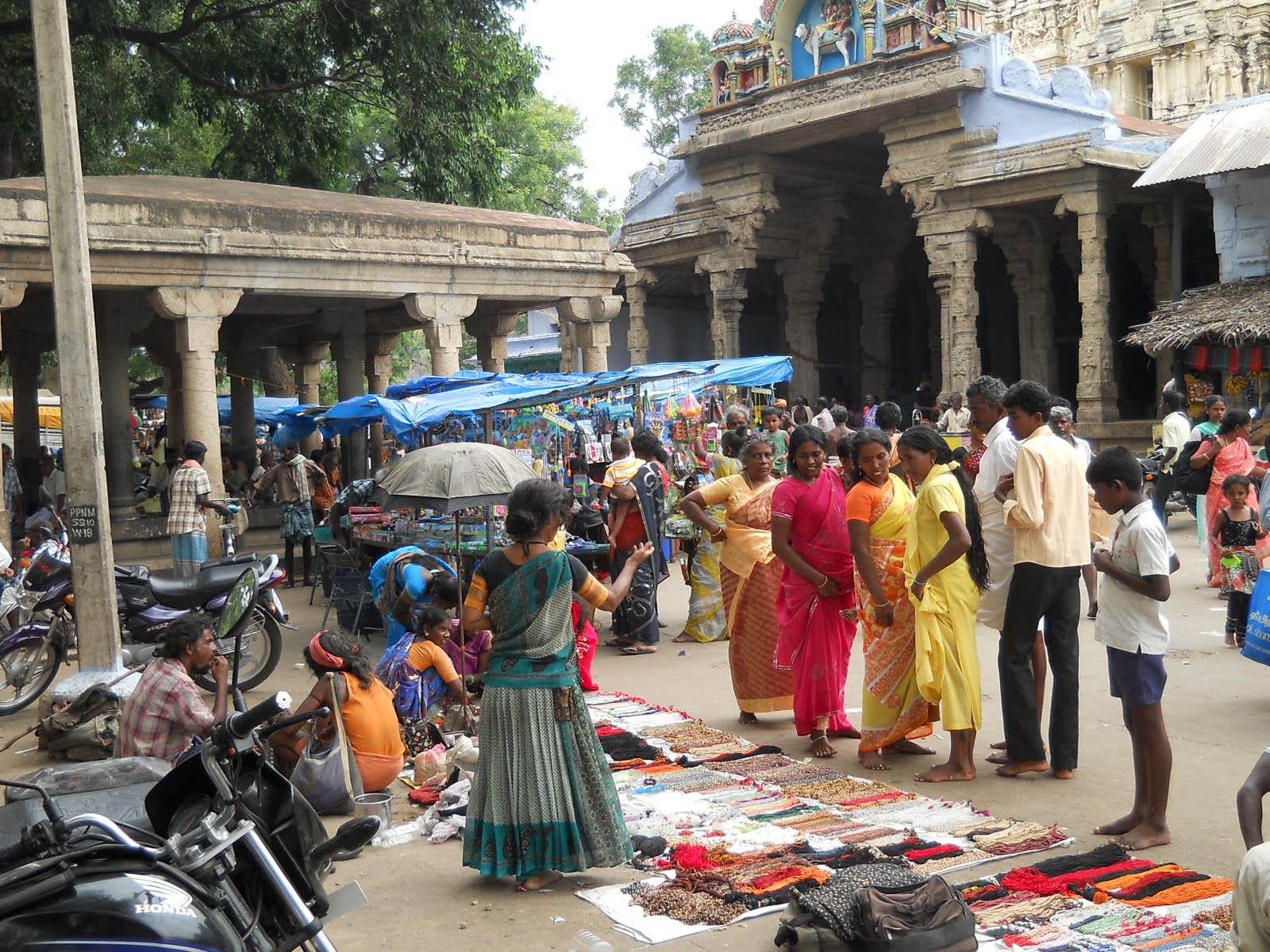
It’s fascinating that people keep century-old traditions in these modern times, but the downsides of tradition seem to be kept alive as well. Even the clothes reflect an inequality between men and women, deeply rooted in their society. While women are wrapped up like candy – I’ve been told that a sari is very uncomfortable and hot, because of the many layers of cloth – men walk around in their short kilts, often proudly parading their fat brown bellies. As for the anklets, although they are my favorite piece of their jewelry, I can’t help but interpret them as “I want to hear wherever my woman goes”, a bit like a cowbell – but that's probably exaggerated. Either way, the relations between men and women are very restricted. Girls and boys are not really allowed to interact until they get married – a marriage that is, in a vast majority of the cases, arranged (official numbers are hard to find; many sources on the internet say 95% in India). Arranged marriages are, as I understand it, a consequence of another well-known source of inequalities in India: the caste system. Three main elements define communities in India: language, religion and caste. Marrying someone from another community, and especially from a lower caste, is regarded as a disgrace. That’s why marriages are arranged, and that’s why contact between boys and girls is restricted: falling in love with the wrong person could ruin their lives. Bhanu, my host in Cuddalore, comes from a Hindu family and married, out of love, a Christian, supposedly from a lower caste. According to what she told me, she seems to live in permanent conflict with most members of her family. I lived and worked on a university campus, where the canteens were separated for boys and girls - as were, of course, the dorms. And – with my legendary sense of observation, it took me a while to notice it – in buses, the front seats, where I usually sat at first, are exclusively occupied by women (yes, it took me a while to notice; and even when I did notice, the first few times I just thought :"wow, I'm surrounded by ladies! It must be my magnetic charm....").
Religion and caste influence more than just relationships between men and women. One day, at the copy shop, I saw someone printing his resume. Apart from mentioning religion – that alone is pretty unusual to us – the personal data included “community”, a two-letter abbreviation. I questioned Bhanu about it, and she told me that it was, in effect, the caste. If someone from a higher caste applies for the same job as you, she said, you will never get it, no matter how qualified you are. On the other hand, there seems to be some positive discrimination, as political actions are being undertaken to improve the situation of people from lower castes. The Indian law contains a controversial quota system for employment and education, referred to as “reservation” (http://en.wikipedia.org/wiki/Reservation_in_India). I didn’t realize the caste system was official; indeed, it’s Indian government that gives you a “caste certificate” and thus puts you in a fictive category with names like “backward classes”. I must admit the caste system is complex, and I would need to do much more research to fully understand it. Apparently, the use of castes by the government was initiated by the British, who grouped the population into communities, equivalently to their own class system, to facilitate the organization of the country. This grouping was based on existing religious castes and tribes. There was a certain hierarchy in these castes, but the British made it more rigid than it was. So any person in India is a member of some caste, usually associated with the occupation of his ancestors. And this caste is classified in one of the big groups, like “backward classes” or “upper classes”. These big groups are the ones that determine the quota for employment and education. When it comes to marriage, people usually stay inside their specific caste. (I’m sure some of you understand this better than I do; feel free to explain!) Another tradition that is still in use is the payment of a dowry. The family of the bride pays a sum of money (or gives a car, or a TV, ...) to the family of the groom; the higher the caste, the higher the sum. The couple usually moves in with the husband's family; so I guess the dowry can be considered as a payment for the wife's food and accommodation. What people don't really seem to know, is that Indian law prohibits the payment of dowry since 1961. The dowry system unavoidably led (and leads?) to sex selection. That's why prenatal determination of sex is illegal here in India - to prevent sex-selective abortion.
Apart from caste, I have mentioned religion. “What is your religion?” is a very common question in India. I have met many Hindus, Muslims and Christians, and they have one thing in common: all of them are very dedicated to their religion. When I answer, as I always do, “no religion; I’m atheist”, they usually look at me as if I came from another planet. It’s funny, by the way, to go to church and see all these Indian people being more devoted Christians then our grandparents ever were. It makes you realize how little religion has to do with culture, I guess – religion is shaped to fit the local culture, and not the contrary. People who are scared of “the Muslims” or “the Hindus” should come to India: people here are Hindu, or Muslim, or Christian, or Sikh, or Sufi, or whatever, but in the end I find it similarly hard to interact with either one of them, simply because they are Indians, and Indian culture is so different from European culture (and even that last statement, I realize, is probably an unacceptable generalization).
Now, all of this – the religion, the castes, the chasteness – is just the cover, the official truth. Not all the young people actually want an arranged marriage, or to have no contact with the opposite sex until they get married, or to be able to marry only someone from their own caste. But they don’t really have a choice. The way I see it – but I’m just guessing; I wish I was an anthropologist, and a historian, and a theologist – people got stuck in this community-based system. No-one ventures not to be religious, or to marry someone from another community, or to wear jeans, or they will be expelled from their community and become outcasts. This means conflict, struggling to find a job, and not being able to marry their children; so it’s just easier to play along. The risks are just too high; if the truth comes out, and you get a bad reputation, you will have a very hard time getting married – especially if you’re a girl. Sometimes it gets even worse; every couple of weeks, I read things like “girl hacked to death for eloping with lover”, “couple shot dead in honour killing in Punjab”, “yet another ‘honour killing’ in Haryana”. It used to be not so very different in our society (apart maybe from the killings). I know my grandmother’s marriage was kind of arranged, and when they went dancing it was never without the company of chaperons; and I suppose that if she would have fallen in love with a factory worker, she wouldn’t even have to think about marrying him. How did it change, then? The sexual revolution, I guess? The only way to break out of that system of hypocrisy is when some strong personalities, some rebels, say what everybody thinks and do what every wants to do. Many of the heroes of our recent generations are rebels: Elvis Presley, James Dean, Marilyn Monroe, Bob Dylan, Serge Gainsbourg, Jim Morrison, Madonna, … That’s the kind of people who push radical changes in society, where everybody gets rid of those self-imposed handcuffs and finally breaks out of that vicious circle of hypocrisy. I asked one of my friends about singers and actors here in Tamil Nadu, and he told me they are just as hypocrite as everybody else, if not more. They try to look like ideal son-in-laws, while they probably take drugs and party more than other people. Their pop stars are (or pretend to be) conformists, who are religious, chaste, and care about their family. What a contrast with the Lady Gagas, Paris Hiltons and Kurt Cobains of our Western culture! I'm not saying that they should have Lady Gagas – I begging them not to – but I think maybe some rebellion wouldn't do harm. There is hope, though. Especially in the cities, things aren’t that extreme anymore - actually, these things I talked about hold mainly for villages. In big cities, people dress however they want, have boyfriends and girlfriends, and even marry out of love sometimes. This is slowly spreading out to the rural areas. Parents of the next generation will probably be much milder to their children, and the old system will slowly disappear. I hope they will keep wearing their traditional clothes every once in a while, though, because it's a pleasure to the eye.
June 7, 2010
English vocabulary, Chinese football and Indian roads
When we got back from the trip to Ooty and Mysore, I still didn’t know what I was going to do for Blessing Kids. Bhanu took me to a village to meet a lady who has a trust that takes care of the physically disabled. She asked me if I could conduct some sort of summer camp for children, where I would teach them English and play games with them. I told Bhanu this wasn’t exactly what I had come to do, and that I wasn’t really qualified to do it. But since there was nothing else to do – because of the summer holidays, her own projects weren’t running – I agreed to give it a try for two weeks. This humble engineer had to convert himself into a merciless English teacher. I was going to have to take care of 15 healthy and 15 disabled children, on my own, starting the next day. With hindsight, I realize this was madness; luckily, it never got to this point.
The next day, without any preparation, I took care of 11 children, only one of which was slightly disabled. I improvised, testing their basic reading, writing and language skills and letting them play their own games. That was on Friday; the next Monday I went back to the same village, better prepared this time. A couple of children had been added to the group, so, flexible as I am, I tested their knowledge too and let them join in. The differences in education were big, ranging from almost illiterate to a good knowledge of basic English vocabulary and spelling. It wasn’t easy, but I managed to play some language games and I started to really get to know the children. You can imagine my frustration when the next morning, an hour before leaving for work, I was told I would go to another village. That’s where I spent the rest of the two weeks. I taught English, literally under a tree, with nothing more than a chair and a tiny blackboard. I had to start remembering names and testing knowledge all over again. The group of children, apart from a couple of faithful followers, changed a lot; almost every day, children would leave or join the group. Again, there were big differences in education level, and also in age – the youngest kid was 7 years old, the oldest one 14.
The biggest problem was that I had no translator. Luckily, the oldest children had a reasonable level of English. They learn it at school, 45 minutes every day, and some of the children had just completed their 5th year. No need to explain them what a cucumber or a helicopter is, or to tell them how to write those words. But the teachers in Tamil Nadu seem to overlook some crucial points. Try to ask these children a question – or anyone Tamil Nadu, for that matter – and you will most likely end up in a mad house. They don’t seem to ever even have heard words like “why”, “where” or “who”. What’s more, some basic verbs, like “to know”, “to mean” or “to understand”, seem to be unknown to them as well. What makes communicating even more difficult, is that people here have a very hard time admitting they don’t understand a single word of what you’re trying to tell them. They usually say “okay”, or “yes”, or just repeat part of what you said. So imagine conversations like:
Me: Who took the ball yesterday?
Children: …
Me: Who, which person? Don’t you know what “who” means?
Children: …
Me: Who knows what “who” means?
Children: …
Me: (slowly) Who knows what “who” means?
Children: (in chorus, at the same speed) Oo no what oo min.
Me: No no, I’m asking you, question: who knows what “who” means?
Children: …
Me: Anand, do you know what “who” means?
Anand: Okay, sir.
Me: (sigh) Do…you, Anand (pointing at Anand)…know (pointing at my head)…what…who, the word who, means?
Anand: (staring blankly)
Me: The meaning of the word who. Meaning, to mean, don’t you know what “to mean” means?
Children: …
Sometimes I did want them to repeat after me, for instance when I was teaching them a song:
Me: Okay, so repeat after me. If you’re happy…
Children: …
Me: Repeat…after…me, okay? So I say (pointing at myself)… you say (pointing at the children).
Children: (enthusiastically, in chorus) I say (pointing at themselves), you say (pointing at me)!
Me: (sigh) Okay, let’s try this. If you’re happy…
Children: …and you know it…
Me: No! Repeat…after…me! Repeat! Don’t you know what “to repeat” means?
Etc…
The biggest challenge came when one day, all of a sudden, a severely disabled boy, both physically and mentally, was dropped between the other children – they were all non-disabled (except for one kid, who proudly showed me his 12 fingers and 12 toes). I tried to explain that it would be really hard to manage, but they told me he was only there for one day and that I didn’t have to take care of him, he would just sit there and observe the others. He ended up staying until the last day, being relatively discrete but claiming my attention every once in a while. And just imagine having the type of conversations I described earlier, with in the background a kid that is literally crawling around and uttering incoherent sounds. Unfortunately, I’m still waiting for those nerves of steel I ordered a couple of months ago.
Luckily, the number of children rarely exceeded 15, and I worked only from 10am to 3pm (with lunch break). I still had two challenging weeks, though. It was no doubt the most difficult part of my trip until now; I felt lonely, discouraged by the many problems, and I missed the careless life of a backpacker. But I dealt with it the only way I could: trying to be the best darn English teacher I could. Every day I spent several hours preparing games and exercises; luckily, I had some reference material from someone who did something similar before. When I taught them vocabulary, things usually went well. We had a lot of fun playing games like Memory and Pictionary; it was rewarding to hear them enthusiastically cry out words I had taught them. During the breaks, we played games I remembered from my childhood – the biggest hit was Chinese football. “Sir, sir, Chinese football, sir!”, I can still here them call out every five minutes. So I managed, but I still felt reluctant to go to work, and I was relieved every time that part of the day was over.

In the weekends, I usually went to Pondicherry, where thanks to the Danish girl I knew some other volunteers. Before going to Cuddalore, I had this romantic idea of being completely isolated in some Indian village; but when you have to face big challenges every day in an unfamiliar environment, it’s such a relief to have a beer and talk to people you can actually communicate with, that it’s hard to renounce. On weekdays, my favorite way of escaping reality was my scooter. After that first time I rented a moped in Pondy, I decided the fun it gave me was worth taking the risk of facing Indian traffic – as a compromise, I wore a helmet, contrary to 99.9% of local drivers. It was interesting to become an active part of the crazy traffic I had been observing for several months. It was exhausting at first, but once I got the hang of it – left thumb on the horn, the rest of the fingers on the brake, and following the most important (and only) priority rule: “I always have priority, except if you’re big enough to kill me”– I enjoyed it a lot. It was a way to feel free, and to explore the surroundings. Around Cuddalore like in all of India, I love the roads. I drove among many motorbikes – a lot of them with women sitting sideways –, cars, noisy autorickshaws, rusty bicycles, bullock carts, and unreasonably fast trucks and buses with their loud horns, all overtaking each other from both sides, honking frantically. The dusty roadside is populated by women in their colorful sarees, sometimes carrying things on their heads, men adjusting their lunghis (traditional skirts), kids in their school uniforms, and various animals like cows, goats and dogs, who have the great habit of crossing the road at the most random moments – quite unusual obstacles. Sometimes, when there was not too much traffic around, I would pick up speed and enjoy the green landscape flashing by, feeling free as a bird.
After two weeks, as the relative comfort of routine was slowly setting in, my task of English teaching came to an end. I was still wondering what I was going to do next, when one night Bhanu suggested me to go traveling for two weeks and come back in June. Because of the holidays, there was no work for me, and I could take the opportunity to do some tourism before the monsoon came. Even though that sounded like a good plan, and in spite of the tough time I had had, I didn’t feel like leaving; I really started to feel at home in Melpattambakkam, and I would miss cruising around on my scooter and sitting on my terrace, gazing at the fields and palm trees that surrounded me. I would get bored if I stayed, though, so I decided to leave. And that, ladies and gentlemen, was the start of a new adventure; I will tell you all about it in my next story.
The next day, without any preparation, I took care of 11 children, only one of which was slightly disabled. I improvised, testing their basic reading, writing and language skills and letting them play their own games. That was on Friday; the next Monday I went back to the same village, better prepared this time. A couple of children had been added to the group, so, flexible as I am, I tested their knowledge too and let them join in. The differences in education were big, ranging from almost illiterate to a good knowledge of basic English vocabulary and spelling. It wasn’t easy, but I managed to play some language games and I started to really get to know the children. You can imagine my frustration when the next morning, an hour before leaving for work, I was told I would go to another village. That’s where I spent the rest of the two weeks. I taught English, literally under a tree, with nothing more than a chair and a tiny blackboard. I had to start remembering names and testing knowledge all over again. The group of children, apart from a couple of faithful followers, changed a lot; almost every day, children would leave or join the group. Again, there were big differences in education level, and also in age – the youngest kid was 7 years old, the oldest one 14.
The biggest problem was that I had no translator. Luckily, the oldest children had a reasonable level of English. They learn it at school, 45 minutes every day, and some of the children had just completed their 5th year. No need to explain them what a cucumber or a helicopter is, or to tell them how to write those words. But the teachers in Tamil Nadu seem to overlook some crucial points. Try to ask these children a question – or anyone Tamil Nadu, for that matter – and you will most likely end up in a mad house. They don’t seem to ever even have heard words like “why”, “where” or “who”. What’s more, some basic verbs, like “to know”, “to mean” or “to understand”, seem to be unknown to them as well. What makes communicating even more difficult, is that people here have a very hard time admitting they don’t understand a single word of what you’re trying to tell them. They usually say “okay”, or “yes”, or just repeat part of what you said. So imagine conversations like:
Me: Who took the ball yesterday?
Children: …
Me: Who, which person? Don’t you know what “who” means?
Children: …
Me: Who knows what “who” means?
Children: …
Me: (slowly) Who knows what “who” means?
Children: (in chorus, at the same speed) Oo no what oo min.
Me: No no, I’m asking you, question: who knows what “who” means?
Children: …
Me: Anand, do you know what “who” means?
Anand: Okay, sir.
Me: (sigh) Do…you, Anand (pointing at Anand)…know (pointing at my head)…what…who, the word who, means?
Anand: (staring blankly)
Me: The meaning of the word who. Meaning, to mean, don’t you know what “to mean” means?
Children: …
Sometimes I did want them to repeat after me, for instance when I was teaching them a song:
Me: Okay, so repeat after me. If you’re happy…
Children: …
Me: Repeat…after…me, okay? So I say (pointing at myself)… you say (pointing at the children).
Children: (enthusiastically, in chorus) I say (pointing at themselves), you say (pointing at me)!
Me: (sigh) Okay, let’s try this. If you’re happy…
Children: …and you know it…
Me: No! Repeat…after…me! Repeat! Don’t you know what “to repeat” means?
Etc…
The biggest challenge came when one day, all of a sudden, a severely disabled boy, both physically and mentally, was dropped between the other children – they were all non-disabled (except for one kid, who proudly showed me his 12 fingers and 12 toes). I tried to explain that it would be really hard to manage, but they told me he was only there for one day and that I didn’t have to take care of him, he would just sit there and observe the others. He ended up staying until the last day, being relatively discrete but claiming my attention every once in a while. And just imagine having the type of conversations I described earlier, with in the background a kid that is literally crawling around and uttering incoherent sounds. Unfortunately, I’m still waiting for those nerves of steel I ordered a couple of months ago.
Luckily, the number of children rarely exceeded 15, and I worked only from 10am to 3pm (with lunch break). I still had two challenging weeks, though. It was no doubt the most difficult part of my trip until now; I felt lonely, discouraged by the many problems, and I missed the careless life of a backpacker. But I dealt with it the only way I could: trying to be the best darn English teacher I could. Every day I spent several hours preparing games and exercises; luckily, I had some reference material from someone who did something similar before. When I taught them vocabulary, things usually went well. We had a lot of fun playing games like Memory and Pictionary; it was rewarding to hear them enthusiastically cry out words I had taught them. During the breaks, we played games I remembered from my childhood – the biggest hit was Chinese football. “Sir, sir, Chinese football, sir!”, I can still here them call out every five minutes. So I managed, but I still felt reluctant to go to work, and I was relieved every time that part of the day was over.
(Me with some of the children, under the tree where I taught them English)

In the weekends, I usually went to Pondicherry, where thanks to the Danish girl I knew some other volunteers. Before going to Cuddalore, I had this romantic idea of being completely isolated in some Indian village; but when you have to face big challenges every day in an unfamiliar environment, it’s such a relief to have a beer and talk to people you can actually communicate with, that it’s hard to renounce. On weekdays, my favorite way of escaping reality was my scooter. After that first time I rented a moped in Pondy, I decided the fun it gave me was worth taking the risk of facing Indian traffic – as a compromise, I wore a helmet, contrary to 99.9% of local drivers. It was interesting to become an active part of the crazy traffic I had been observing for several months. It was exhausting at first, but once I got the hang of it – left thumb on the horn, the rest of the fingers on the brake, and following the most important (and only) priority rule: “I always have priority, except if you’re big enough to kill me”– I enjoyed it a lot. It was a way to feel free, and to explore the surroundings. Around Cuddalore like in all of India, I love the roads. I drove among many motorbikes – a lot of them with women sitting sideways –, cars, noisy autorickshaws, rusty bicycles, bullock carts, and unreasonably fast trucks and buses with their loud horns, all overtaking each other from both sides, honking frantically. The dusty roadside is populated by women in their colorful sarees, sometimes carrying things on their heads, men adjusting their lunghis (traditional skirts), kids in their school uniforms, and various animals like cows, goats and dogs, who have the great habit of crossing the road at the most random moments – quite unusual obstacles. Sometimes, when there was not too much traffic around, I would pick up speed and enjoy the green landscape flashing by, feeling free as a bird.
(A couple of random pictures of roads)


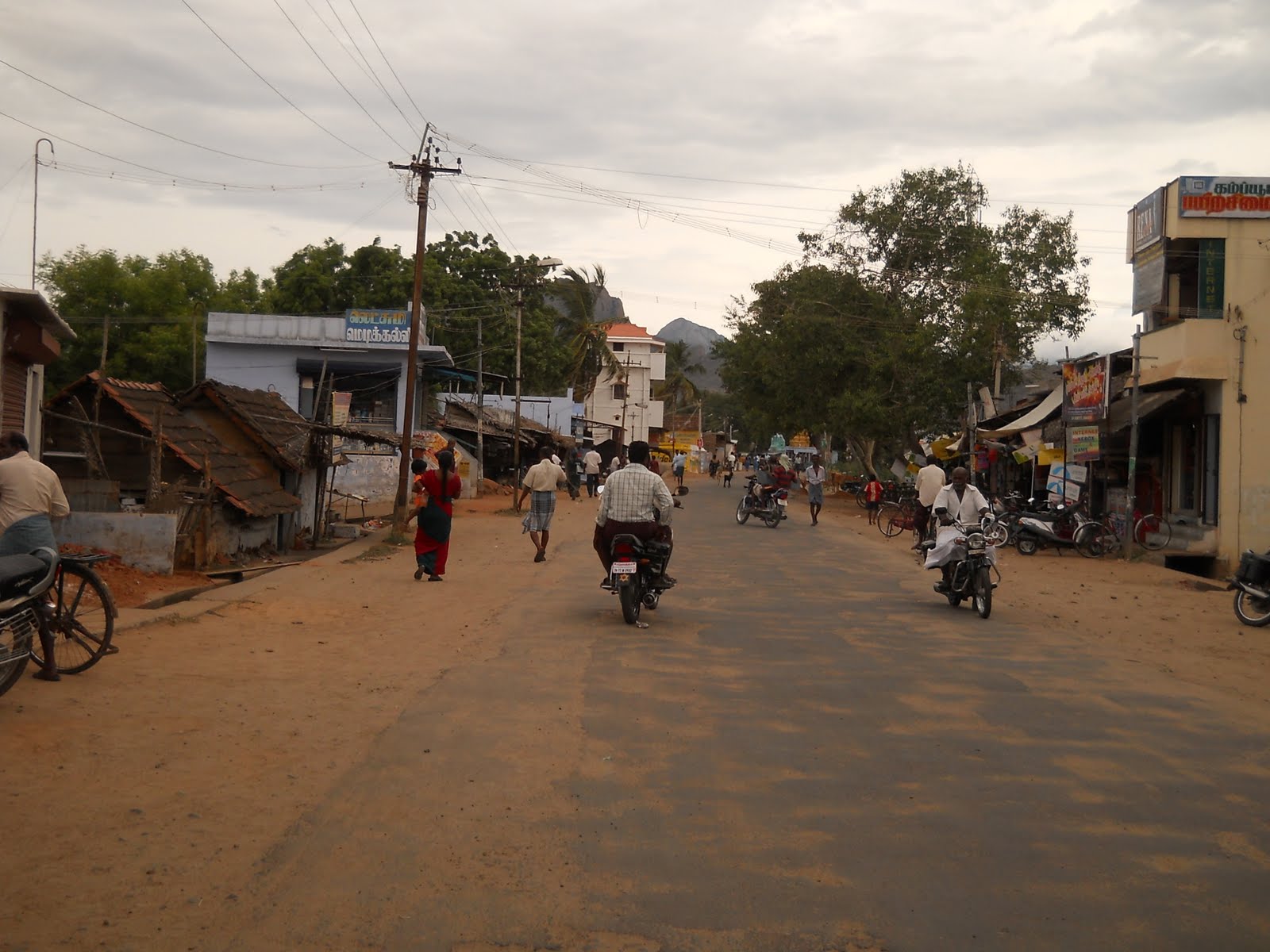

After two weeks, as the relative comfort of routine was slowly setting in, my task of English teaching came to an end. I was still wondering what I was going to do next, when one night Bhanu suggested me to go traveling for two weeks and come back in June. Because of the holidays, there was no work for me, and I could take the opportunity to do some tourism before the monsoon came. Even though that sounded like a good plan, and in spite of the tough time I had had, I didn’t feel like leaving; I really started to feel at home in Melpattambakkam, and I would miss cruising around on my scooter and sitting on my terrace, gazing at the fields and palm trees that surrounded me. I would get bored if I stayed, though, so I decided to leave. And that, ladies and gentlemen, was the start of a new adventure; I will tell you all about it in my next story.
Subscribe to:
Posts (Atom)
